The Invisible Commander
Military commanders throughout history have recognized weather as a force that can be as decisive as any army. Sun Tzu wrote about using weather conditions to gain tactical advantage, and Napoleon famously battled both enemies and elements across Europe and Russia. Rain can turn fields into impassable mud, snow can freeze armies in place, fog can hide troop movements, and storms can scatter fleets. The greatest commanders learned to use weather to their advantage while their opponents struggled against it.
Storms That Saved Nations
In 1281, a massive typhoon destroyed the Mongol invasion fleet headed for Japan, an event the Japanese called the kamikaze or "divine wind." Three centuries later, storms scattered the Spanish Armada in 1588 as it attempted to invade England, with more ships lost to weather than to English guns. These storms altered the course of history — without them, both Japan and England might have been conquered, fundamentally changing the development of two major civilizations.
- •The 1281 typhoon destroyed an estimated 4,400 Mongol ships and killed up to 100,000 troops
- •The Spanish Armada lost roughly half its ships, many to storms off the coast of Ireland and Scotland
- •In 1274, an earlier typhoon had also disrupted the first Mongol invasion attempt against Japan
Winter Warfare
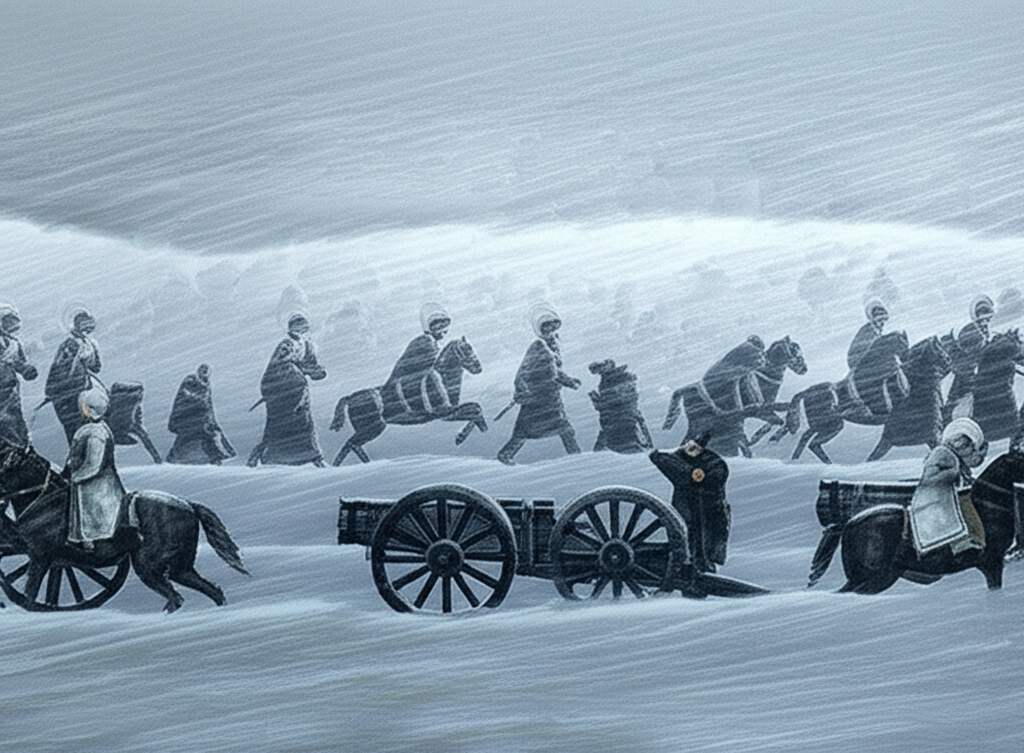
Cold weather has destroyed more armies than any enemy force. Napoleon’s invasion of Russia in 1812 ended in catastrophe as the Grande Armée was devastated by the Russian winter during its retreat from Moscow. Of the roughly 600,000 troops who entered Russia, fewer than 100,000 returned. The Battle of the Bulge in 1944 was fought in bitter cold and heavy snow that grounded Allied air support and favored the German surprise attack. At the Battle of Chosin Reservoir in 1950, temperatures dropped below minus 30 degrees, affecting weapon function and causing massive casualties from frostbite.
It is worth separating the genuine role of cold from the myth of “General Winter.” The Russian winters of 1812 and 1941-42 were in fact colder than average, but most of Napoleon's and Hitler's losses came before the worst cold hit — starvation, typhus, and stretched supply lines had already hollowed out both armies. Cold was the killing blow, not the whole cause. Historians now describe weather as a force multiplier: it rarely creates a defeat from nothing, but it can turn a difficult situation into a catastrophe with breathtaking speed.
Rain, Mud, and Fog
The Battle of Agincourt in 1415 was decisively influenced by heavy rain that turned the battlefield into deep mud, trapping French knights in their heavy armor while English longbowmen picked them off from distance. The Battle of Passchendaele in 1917 became synonymous with the horrors of mud warfare, with soldiers drowning in shell craters filled with liquid mud. Fog concealed Washington’s retreat from Long Island in 1776, saving the Continental Army from destruction.
- •At Agincourt, the mud was so deep that French knights who fell could not stand up again
- •Passchendaele cost over 500,000 casualties on both sides for an advance of just five miles
- •The fog at Long Island allowed Washington to evacuate 9,000 troops across the East River undetected
- •Desert heat caused more casualties than enemy fire in many Middle Eastern campaigns
D-Day and the Weather Gamble
The D-Day landings on June 6, 1944 were one of the most weather-dependent military operations in history. Eisenhower needed a narrow window of acceptable weather for the amphibious landing, and his chief meteorologist Group Captain James Stagg identified a brief clearing in what was otherwise terrible weather. The German meteorologists missed this clearing and believed no invasion was possible, leading Rommel to leave Normandy for his wife’s birthday. The weather gamble paid off and helped achieve surprise.
Weather Clues in BattleGuess
Weather conditions are valuable visual clues in BattleGuess images. Snowy landscapes suggest winter battles like the Bulge or Chosin Reservoir. Muddy, rain-soaked fields point to battles like Agincourt or Passchendaele. Desert heat waves suggest Middle Eastern or North African engagements. Stormy seas point to naval battles where weather played a decisive role. Training yourself to read weather conditions in battle images is one of the most effective strategies for narrowing down the possibilities at BattleGuess.
Heat, Sand, and Thirst
Cold gets the most attention, but heat and drought have decided just as many battles. Campaigns in deserts, steppes, and tropical zones often came down to who controlled the wells.
- •Hattin (1187) — Saladin won by controlling water and letting Crusader heat exhaustion do the fighting
- •The Mongol invasion of Hungary (1241) — a rare case where sudden spring mud slowed Mongol cavalry long enough for Europe to recover
- •Gallipoli (1915) — summer heat and dysentery did more damage to Allied troops than Ottoman bullets in the opening months
- •El Alamein (1942) — the Sahara heat shaped how both armies moved, fought, and maintained vehicles
- •The Korean Chosin Reservoir campaign (1950) — not only freezing but driven by sudden thaws that turned roads into impassable sludge
Forecasting in Modern Warfare
Modern militaries invest heavily in weather forecasting because precision weapons, helicopters, and electronic systems are surprisingly weather-sensitive. A fog bank can ground a drone swarm. Humidity affects artillery ballistics enough to matter for long-range fire. Desert dust can damage jet engines in hours. Cold-soaked lithium batteries can lose half their capacity. The side that predicts these conditions hours earlier than its opponent gets genuine operational advantage — which is why every major military fields its own meteorological service and why dedicated weather satellites are now routine military hardware.
Keep Exploring BattleGuess
Weather interlocks with naval engagements, WWII gambles, and countless famous defeats. These guides deepen the story.
- •10 Most Decisive Battles in History — many decided by snow, mud, or storm
- •5 Turning Points of World War II — the D-Day weather gamble and the Russian winter
- •Top 10 Naval Battles That Ruled the Waves — Salamis, the Spanish Armada, and Trafalgar’s weather
- •Battlefield Tactics Explained for Beginners — how commanders turned terrain and climate into force multipliers
- •Hunt for weather-decided battles in the Battle encyclopedia or test your eye on today’s game.