The Shot Heard Round the World
The American Revolution began with a confrontation between British regulars and colonial militia at Lexington and Concord in April 1775. What started as a local rebellion quickly escalated into a full-scale war for independence. The Continental Army, led by George Washington, faced the most powerful military in the world with a force of farmers, merchants, and tradespeople who had to learn the art of war while fighting it.
Bunker Hill: Proving Colonial Resolve
The Battle of Bunker Hill in June 1775, though technically a British victory, proved that colonial forces could stand against professional British soldiers. The famous order to wait until the enemy was close before firing demonstrated the discipline and determination of the American militia. British casualties were so severe that they won the ground but lost the confidence that the rebellion could be quickly suppressed.
Trenton and Saratoga: Turning the Tide
Washington’s crossing of the Delaware River on Christmas night 1776 and the surprise attack on Hessian forces at Trenton was a masterstroke of daring that revived American morale at its lowest point. The Battle of Saratoga in 1777 was the true turning point of the war, as the American victory convinced France to enter the conflict as an ally. French military and naval support would prove decisive in the final campaigns of the war.
- •Washington’s army was near collapse before Trenton — enlistments were expiring and morale was shattered
- •Saratoga was the first time an entire British army surrendered in the field
- •French entry brought money, ships, professional soldiers, and international legitimacy
- •Spain and the Netherlands also joined the war against Britain, stretching its resources globally
The Role of Foreign Allies
The American Revolution was won not by the colonists alone but with crucial support from European allies. France provided soldiers, a powerful navy, and critical financial support. The Marquis de Lafayette served as a major general in Washington’s army. Baron von Steuben, a Prussian military officer, trained the Continental Army at Valley Forge and transformed it into a professional fighting force. Polish engineers like Tadeusz Kościuszko designed fortifications that proved decisive at several engagements.
Yorktown: The Final Victory
The Siege of Yorktown in 1781 combined American and French forces in a textbook siege operation against the British army under Cornwallis. French naval forces blocked the Chesapeake Bay, preventing British reinforcement or evacuation. After weeks of bombardment and trench warfare, Cornwallis surrendered his entire army. Though the war would not officially end until the Treaty of Paris) in 1783, Yorktown effectively secured American independence.
Revolutionary Battles in BattleGuess
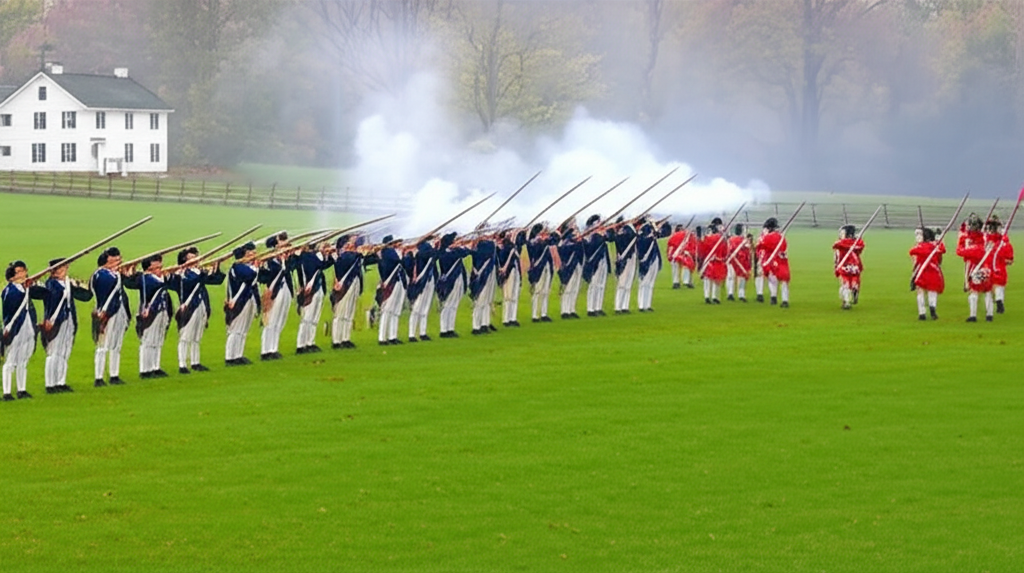
American Revolution battles in BattleGuess feature distinctive visual elements: colonial militia in civilian clothing alongside Continental Army uniforms, British redcoats in formation, and the rural American landscape of forests, rivers, and farmland. These battles appear in the American Wars era and range from easy (Bunker Hill, Yorktown) to harder (Cowpens, Monmouth). Pay attention to the style of uniforms and weapons to distinguish Revolutionary War battles from later American conflicts.