The Chinese Origins
Gunpowder was invented in China around the 9th century CE, initially used in fireworks and later adapted for military purposes. Chinese armies deployed fire lances, primitive grenades, and early cannons centuries before the technology reached Europe. The Mongol conquests helped spread gunpowder westward, and by the 13th century, knowledge of gunpowder weapons had reached the Islamic world and Europe. This technology transfer, accelerated by warfare and trade, would fundamentally reshape the global balance of power.
- •The earliest known gunpowder formula appears in a Chinese text from 850 CE
- •Fire lances — bamboo tubes filled with gunpowder — were the first personal firearms
- •Chinese armies used gunpowder bombs, rockets, and early cannons by the 12th century
- •The Mongol Empire spread gunpowder technology across Eurasia through conquest and trade
The End of Castle Warfare
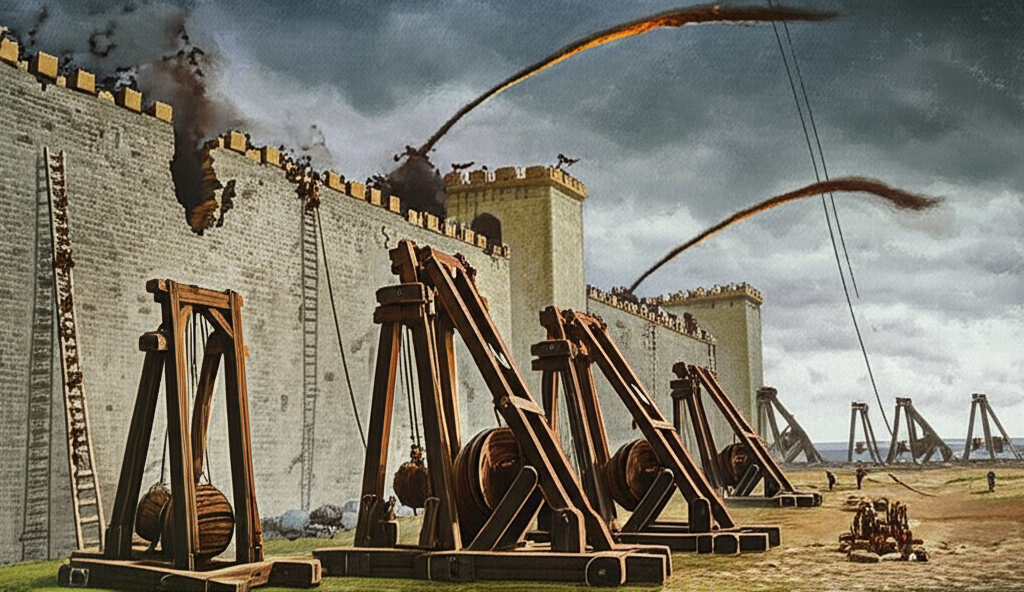
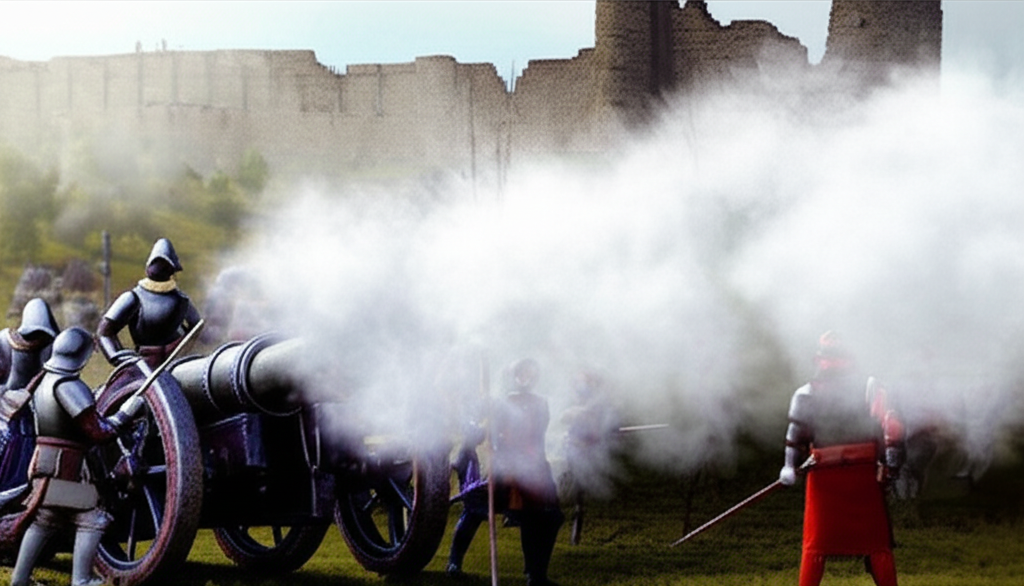
For centuries, castle walls provided near-impregnable defense. A well-stocked castle could hold out for months against a besieging army. Gunpowder artillery changed this equation dramatically. The Ottoman siege of Constantinople in 1453 demonstrated the devastating power of massive bombards against even the strongest fortifications. Within decades, medieval castle design became obsolete, replaced by the low, thick, star-shaped trace italienne fortifications designed to withstand cannon fire. An entire feudal system built around castle defense crumbled alongside the walls.
Infantry Revolution
The matchlock musket and later the flintlock transformed infantry warfare. The armored knight, dominant for centuries, could now be brought down by a peasant with a musket and minimal training. Pike-and-shot formations replaced medieval cavalry charges, and battles like Nagashino (1575) in Japan demonstrated how disciplined musket volleys could shatter cavalry attacks. The evolution from matchlock to flintlock to rifled musket to breech-loading rifle compressed centuries of tactical change into increasingly rapid cycles of innovation.
The Rise of Artillery
Artillery evolved from crude bombards to precision instruments of destruction. By the 18th century, field artillery could be rapidly deployed and repositioned during battle, creating devastating concentrations of firepower. Key developments in artillery technology shaped warfare for centuries.
- •Bronze cannons (15th century) — more reliable than iron, became standard for siege warfare
- •Field artillery (17th century) — lighter guns that could move with armies on the battlefield
- •Explosive shells (19th century) — replaced solid cannonballs, multiplying destructive power
- •Rifled barrels (19th century) — dramatically improved range and accuracy
- •Modern artillery — GPS-guided rounds can hit targets from dozens of miles away
The Napoleonic Revolution
By the Napoleonic era, gunpowder weapons had matured into highly effective tools of war. Napoleon’s massed artillery batteries could devastate enemy formations from over a mile away, and his corps system allowed armies of unprecedented size to maneuver across entire continents. The battles of this era — Austerlitz, Wagram, Borodino — involved hundreds of thousands of soldiers and thousands of cannon, a scale of destruction that would have been unimaginable just three centuries earlier.
Recognizing Gunpowder-Era Battles
In BattleGuess, gunpowder-era battles have distinctive visual markers: clouds of smoke, cannon positions, soldiers in line formations, and fortifications with angled bastions rather than tall walls. Learning to distinguish between early gunpowder battles (loose formations, hand cannons) and later ones (disciplined volleys, field artillery) is key to narrowing down the era and identifying specific battles.