Two Military Giants
Ancient Greece and Rome produced the two most influential military systems in Western history. The Greek phalanx — a wall of overlapping shields and protruding spears — dominated battlefields for centuries. The Roman legion — a flexible formation of sword-armed infantry operating in smaller, maneuverable units — eventually proved even more effective. The clash between these two systems in the battles of Cynoscephalae and Pydna decided which model would dominate the ancient world.
The Greek Phalanx
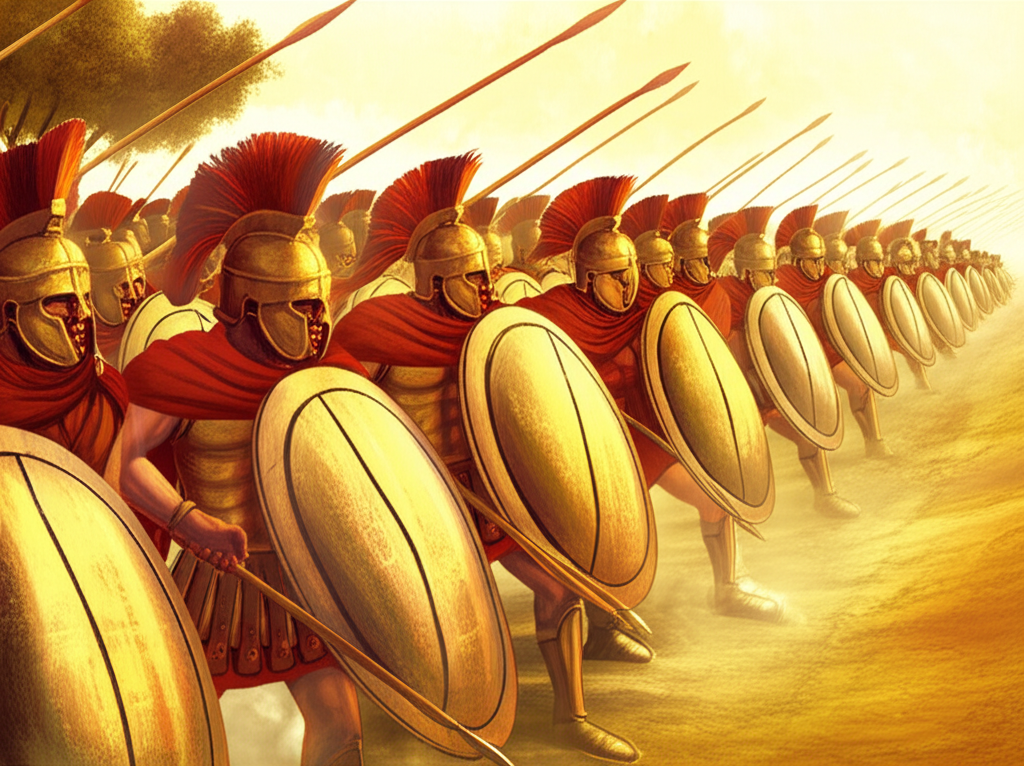
The Greek hoplite phalanx was built around heavy infantry armed with spear and shield, fighting in tight formation where each soldier’s shield protected the man to his left. This system rewarded discipline and cohesion above all else. The Spartan version was the most fearsome, but every Greek city-state fielded some variation. Philip II of Macedon extended the concept with the sarissa pike, creating a formation so deep and bristling with spear points that it was nearly impervious to frontal assault. Alexander the Great used this phalanx as his anvil while his cavalry served as the hammer.
- •The hoplon shield weighed about 7 kg and was made of wood with a bronze facing
- •Phalanx formations were typically 8 ranks deep, though Philip’s Macedonian version could be 16 ranks
- •The main weakness of the phalanx was its vulnerability to flank attacks and rough terrain
- •Greek warfare was initially limited to set-piece battles between citizen-soldiers on flat ground
The Roman Legion
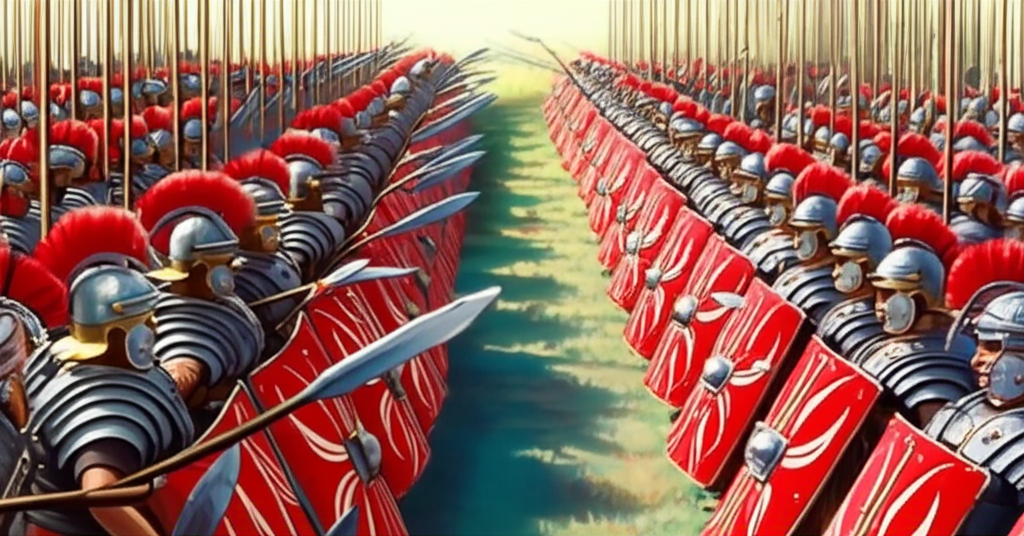
Rome’s military innovation was flexibility. The legion was divided into smaller units called maniples (later cohorts) that could operate independently on the battlefield, adapt to terrain, and replace exhausted troops with fresh ones mid-battle. Roman soldiers fought with the gladius (short sword), which was devastatingly effective in close combat after the initial volley of pila (javelins) disrupted enemy formations. Roman military engineering, logistics, and discipline allowed legions to campaign year-round across vast distances.
- •Roman soldiers carried about 30 kg of equipment and could march 30 km per day
- •The pilum was designed to bend on impact, preventing enemies from throwing it back
- •Roman armies built fortified camps every single night while on the march
- •Professional legionaries served for 25 years, creating an experienced and disciplined force
When They Clashed
The definitive test came at the Battle of Cynoscephalae in 197 BCE, where the Roman legions of Flamininus defeated the Macedonian phalanx of Philip V. The Roman victory demonstrated that the flexible legion could exploit the phalanx’s weakness: its vulnerability to attacks on the flanks and rear, and its difficulty maneuvering on uneven ground. The Battle of Pydna in 168 BCE confirmed this result, effectively ending the age of the phalanx and establishing the legion as the dominant military formation of the ancient world.
Side-by-Side Comparison
Comparing the two systems across key military dimensions reveals why the legion ultimately prevailed.
- •Flexibility — the legion could fight on any terrain; the phalanx required flat ground
- •Unit cohesion — the phalanx was stronger from the front; the legion was strong from all directions
- •Individual training — Roman legionaries were more effective in individual combat than Greek hoplites
- •Logistics — Roman armies were self-sufficient engineers; Greek armies depended on friendly territory
- •Adaptability — Rome adopted enemy tactics and weapons; the phalanx changed little over centuries
Identify the Difference in BattleGuess
In BattleGuess, Greek and Roman battles have distinct visual characteristics. Greek battles feature rounded shields, bronze armor, crested helmets, and tight phalanx formations on open plains. Roman battles show rectangular shields (scutum), segmented armor, and more spread-out flexible formations, often with fortifications or siege works visible. Learning to distinguish these visual signatures instantly narrows your options and helps you identify specific battles within each civilization.