Guide
Ancient Rome vs Ancient Greece: A Military Comparison
By Harry H, developer of BattleGuess · Published 3 April 2026 · Updated · 10 min read
Rome had the better military: the Roman legion beat the Greek phalanx. The phalanx, a deep wall of shields and spears, was nearly unbeatable head-on but could not turn or cross broken ground without opening gaps. The legion, built from small units armed with javelin and short sword, could do both, and at Cynoscephalae in 197 BCE and Pydna in 168 BCE it poured into those gaps and destroyed Macedon's armies.
Key takeaways
- The Greek phalanx was almost unbreakable from the front but fragile on its flanks and on rough ground
- The Roman legion fought in small, flexible units that could turn, rotate fresh troops and exploit gaps
- Cynoscephalae in 197 BCE and Pydna in 168 BCE showed the legion beating the phalanx on the day
- Rome won as much through recruitment, engineering and adaptation as through tactics
Two military systems
Ancient Greece and Rome produced the two most influential military systems in Western history. The Greek phalanx, a wall of overlapping shields and projecting spears, dominated Mediterranean battlefields for three centuries. The Roman legion, a flexible formation of sword-armed infantry fighting in small manoeuvrable units, eventually proved more effective. The clash between the two at Cynoscephalae and Pydna decided which model would dominate the ancient world.
The Greek phalanx
The hoplite phalanx was built around heavy infantry armed with a long spear and a large round shield, fighting in close order so that each man's shield protected the soldier on his left. The system rewarded discipline and cohesion above everything. The Spartans were its most feared practitioners, and the Theban general Epaminondas showed at Leuctra how a deepened wing could smash even them. Philip II of Macedon then extended the idea with the sarissa, a pike up to six metres long, creating a formation so deep and so bristling with spear points that it was almost impervious to frontal assault. Alexander used this phalanx as his anvil while the Companion cavalry served as the hammer, most famously at Gaugamela.
- The hoplite shield weighed about 7 kg, wood faced with bronze
- Hoplite phalanxes were usually eight ranks deep; the Macedonian version could be sixteen
- The formation's weaknesses were its flanks, its rear and any ground that broke up its line
- Early Greek warfare was largely a matter of set-piece battles between citizen-soldiers on flat ground
The Roman legion
Rome's military innovation was flexibility. The legion of the middle Republic was divided into maniples, small units of 120 men that could act independently, adapt to terrain and swap tired troops for fresh ones in the middle of a fight. Legionaries opened with a volley of pila, heavy javelins designed to bend on impact so they could not be thrown back, and then closed with the gladius, a short thrusting sword that was devastating at close quarters. Roman engineering, logistics and discipline let legions campaign year-round and far from home.
- A legionary carried roughly 30 kg of equipment and could march 30 km in a day
- Roman armies fortified a camp every night on the march
- The manipular legion was a citizen militia; the 25-year professional enlistment belongs to the later Empire
- Rome routinely adopted enemy equipment, including the gladius itself, which came from Iberia
When they met
The decisive test came at Cynoscephalae in 197 BCE, where the legions of Flamininus defeated the Macedonian phalanx of Philip V. It was an unplanned encounter on broken hills. Forced to advance across uneven ground, the phalanx opened gaps, and a quick-thinking Roman tribune took twenty maniples into its exposed rear. At Pydna in 168 BCE Aemilius Paullus let the phalanx press forward, watched it fragment on rougher ground, and sent cohorts into every seam. The Macedonian monarchy ended with the battle.
The pattern became the standard Roman method against any rigid formation: make it move, wait for it to lose cohesion, then exploit the gaps. It is worth remembering, though, that the phalanx had already beaten Rome's ancestors. Cannae was a Carthaginian victory won with Hellenistic tactics, and Pyrrhus of Epirus beat Roman armies twice before running out of men.
Side by side
Comparing the two systems across the dimensions that decided battles shows why the legion prevailed.
- Flexibility: the legion could fight on any terrain; the phalanx needed flat ground
- Cohesion: the phalanx was stronger from the front; the legion could face threats from any direction
- Individual fighting: a legionary with sword and large shield was more dangerous in a melee than a pikeman
- Logistics: Roman armies were self-sufficient engineers; Greek armies depended on friendly territory
- Adaptability: Rome copied enemy tactics and weapons; the phalanx changed little over three centuries
- Cavalry: here Greece had the edge, and Alexander's Companions were the finest heavy cavalry of the age
The systems behind the armies
Neither side won through tactics alone. The institutions behind the armies mattered as much as the formations.
- Greek civic armies: hoplites bought their own armour, which limited campaigns to what citizen-farmers could spare from the fields
- Roman conscription and, later, professional service produced a force that could stay in the field for years
- Roman engineering, from roads to siege machinery, sustained operations no Greek state could match
- Naval power: Athens built an empire on triremes; Rome had to learn shipbuilding from Carthage during the Punic Wars
- Citizenship: Rome turned defeated enemies into allies and eventually citizens, multiplying its manpower with every war
What each system left behind
Rome's template shaped later Western armies directly: the standing professional army, military engineering manuals, and rank terms that survive today. Greece's influence is more diffuse but just as deep. The Greek idea of the citizen-soldier tied to a political community underlies the modern national army, and Alexander's combined-arms approach is still taught at staff colleges. The phalanx itself never quite disappeared: Swiss pike squares, the Spanish tercio and the infantry squares that stopped cavalry at Waterloo all worked on the same logic.
Telling them apart in the game
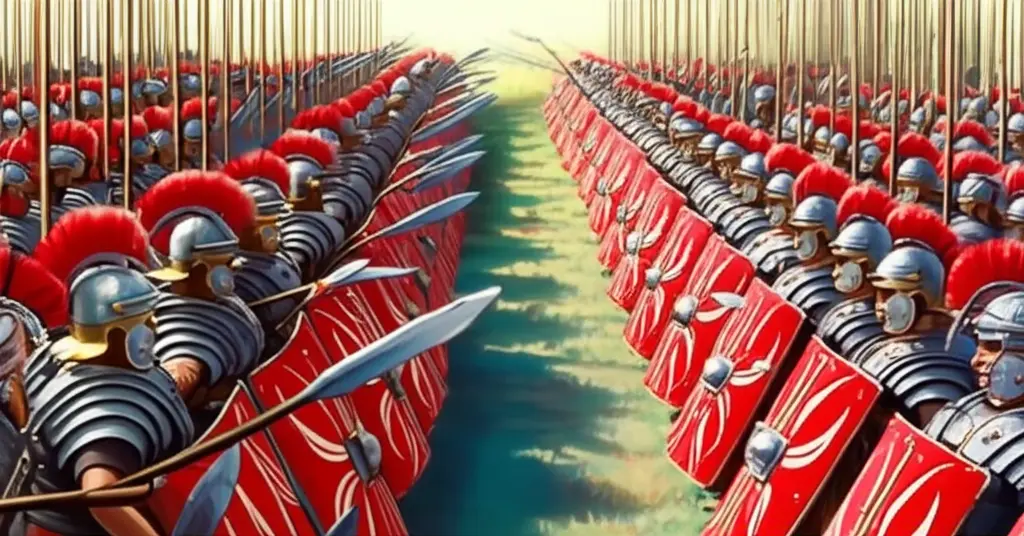
Greek and Roman battles look different in the game's artwork. Greek scenes show round shields, bronze armour, crested helmets and tight formations on open plains. Roman scenes show the rectangular scutum, segmented armour, looser formations and, often, siege works or fortifications. Recognising the era first narrows the possibilities before you look for the specific battle. Try the Ancient Greece and Rome era in Classic mode.
Battles in this guide
Each links to its encyclopedia entry with the date, belligerents, result and further reading.
Common questions
Who would win, Roman legions or the Greek phalanx?
History answered this at Cynoscephalae in 197 BCE and Pydna in 168 BCE, where Roman legions decisively defeated the Macedonian phalanx by exploiting its vulnerability to flank attacks and broken ground.
What was the main weakness of the Greek phalanx?
It was extremely strong from the front but vulnerable on its flanks and rear, and it lost cohesion on rough or uneven ground, which opened gaps that a more flexible enemy could exploit.
How was the Roman legion organized?
The legion of the middle Republic was divided into maniples, and later cohorts, that could operate independently, adapt to terrain and rotate fresh troops into the fighting line.
Did Rome just copy Greek military ideas?
Rome borrowed heavily. Early Roman armies fought in phalanx-like formations themselves, and the gladius came from Iberia. Rome's strength was synthesis: it kept what worked from every enemy it fought and dropped what did not.
Who had better cavalry, Greece or Rome?
Greece, by a clear margin, especially under Macedon. Roman cavalry was mediocre, which is why Rome relied on allied and later auxiliary horsemen from Numidia, Gaul and elsewhere throughout its history.
Did the phalanx ever come back after Pydna?
Not as the dominant formation, but its ideas never disappeared. Byzantine spear walls, Swiss pike squares, the Spanish tercio and the infantry squares used against cavalry into the 19th century all drew on phalanx logic.
Sources and further reading
This guide was compiled from the works below and standard reference accounts. Battle pages linked in the text carry their own sources. Corrections are welcome via the contact details.
- Polybius, The Histories, Book 18: a Greek eyewitness of the Roman system who compared phalanx and legion directly
- Livy, History of Rome, Books 31 to 45: the Macedonian Wars including Cynoscephalae and Pydna
- Roman legion
- Macedonian phalanx
- Battle of Cynoscephalae
- Battle of Pydna
Can you name these battles from a picture?
Every battle in this guide is in the game. Try today's Daily Challenge or pick an era in Classic mode.