Guide
Battlefield Tactics Explained for Beginners
By Harry H, developer of BattleGuess · Published 6 April 2026 · Updated · 9 min read
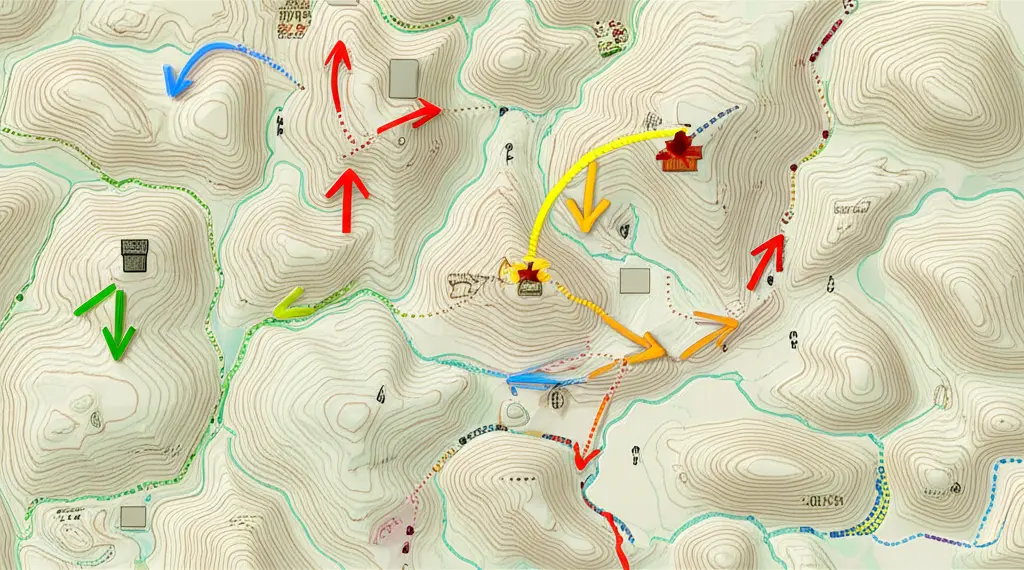
Battlefield tactics are the methods commanders use to arrange and move troops during a fight. Almost all of them come down to a few ideas: hit the enemy where he is weak, usually the flank or rear; hold him in place with one force while another delivers the blow; use terrain to cancel his numbers; and attack when and where he does not expect it. This guide explains each, with the battle that shows it best.
Key takeaways
- Flanking and double envelopment attack the sides of a formation, where it is weakest
- Hammer and anvil pins the enemy with one force while a mobile force strikes from elsewhere
- Defence in depth and good terrain let a smaller army fight a larger one on equal terms
- Surprise and deception have decided as many battles as numbers or weapons
Why tactics matter
A battle is a contest between two forces trying to impose their will on each other. Numbers matter, but how those numbers are used often matters more, and history is full of smaller forces beating larger ones through better tactics. It helps to keep three levels apart. Strategy is the plan for winning the war. Operations is how campaigns and battles are linked together in a theatre. Tactics is how an individual engagement is fought. This guide is about the last of these.
Flanking and envelopment
A flanking attack hits the side of an enemy formation, where it is weakest. A double envelopment attacks both flanks at once and surrounds the enemy. The most famous example is Hannibal's victory at Cannae in 216 BCE, where he deliberately let his centre bend backwards to draw the Romans in, then closed his African infantry and cavalry around them. Around 50,000 Romans died in an afternoon.
Flanking works because formations are almost always strongest facing forward: shields, bayonets, main guns and trained attention all point the same way. Hit the side and soldiers must turn individually while under attack, which is the moment cohesion breaks. The principle scales from a hoplite phalanx to an armoured division. Schlieffen planned a vast flanking wheel through Belgium in 1914, and the German breakthrough at Sedan in 1940 was a Cannae at the level of a whole front. The weapons changed; the geometry did not.
Hammer and anvil
Hammer and anvil uses a strong holding force, the anvil, to pin the enemy in place while a mobile force, the hammer, strikes from another direction. Alexander the Great was its master. At Gaugamela his phalanx held the Persian front while he led the Companion cavalry into the gap that opened beside Darius's centre. The same principle runs through modern combined-arms warfare, where infantry fixes the enemy and armour or aircraft deliver the decisive blow.
The oblique order
An oblique attack concentrates overwhelming force against one end of the enemy line while holding back, or refusing, the other. Epaminondas used it against Sparta at Leuctra in 371 BCE, and Frederick the Great perfected it at Leuthen in 1757, where his Prussians marched behind a line of hills, fell on the Austrian left and rolled up an army twice their size. The idea is to break the decisive point before the rest of the enemy line can react.
Defence in depth and terrain
Not every winning tactic is an attack. Defence in depth means building several defensive lines that the enemy must fight through one after another, losing strength at each. Terrain multiplies a small force: a mountain pass, a river crossing or a narrow strait forces a larger army onto a front where its numbers cannot be brought to bear. Thermopylae is the classic example on land and Salamis at sea. The same logic held at Agincourt, where mud and a narrowing field turned French numbers into a liability.
Deception and surprise
Deception is as old as war. Sun Tzu devoted much of The Art of War to it, and surprise attacks have changed the course of whole conflicts.
- Teutoburg Forest, 9 CE: Arminius led three Roman legions into an ambush along a forest track and destroyed them
- Lake Trasimene, 217 BCE: Hannibal hid his army in the hills above a fogbound lakeshore and caught a Roman army on the march
- Trenton, 1776: Washington crossed the Delaware on Christmas night and surprised the Hessian garrison at dawn
- Okehazama, 1560: Oda Nobunaga struck the Imagawa camp during a thunderstorm and killed a commander with ten times his strength
- The Tet Offensive, 1968: attacks across South Vietnam during a holiday truce were a military failure but a political turning point
- D-Day, 1944: Operation Bodyguard convinced the German high command that the main landing would come at Calais, not Normandy
Common tactical mistakes
Why armies lose is as instructive as why they win, and history's great defeats share a short list of errors.
- Overextension: advancing too far from supply, as Napoleon did in Russia in 1812
- Underestimating the enemy: assuming victory is certain, as the Persians did at Marathon
- Fighting on the wrong ground: as the Crusaders did at Hattin, lured into a waterless plateau in July
- Ignoring intelligence: dismissing warnings of enemy intent, as at Pearl Harbor in 1941
- Frontal assaults on strong positions: as at Fredericksburg in 1862, where Union attacks against a stone wall cost 12,000 casualties
Tactics that shaped modern warfare
Classical tactics evolved into modern doctrine once industrial firepower changed the rules. Several twentieth-century approaches now sit alongside the older ideas in any tactical toolkit.
- Infiltration tactics: developed by German stormtroopers in 1918, bypassing strongpoints to strike command posts and supply
- Combined arms: infantry, armour, artillery and aircraft integrated so that each covers the others' weaknesses
- Manoeuvre warfare: defeating an enemy by breaking his ability to respond rather than destroying him piece by piece
- Counter-insurgency: securing populations rather than terrain, refined from Malaya in the 1950s onwards
- Multi-domain operations: coordinating land, sea, air, space and cyber effects through information superiority
How to read a battle like a historian
The same battle can look completely different depending on how you read it. Historians usually work through the same checklist: what did each side want, what did each side know about the other, what were the terrain and weather, what forces did each have, and where were the decision points at which the result could have gone the other way. Try it on a battle you already know, such as Gettysburg, Waterloo or Midway, and the textbook story usually turns out to be much thinner than the full picture.
Spotting tactics in the game
Many battles in the game are drawn at the moment their defining tactic was executed. Forces closing around a trapped army suggest Cannae or Stalingrad. A cavalry charge into an exposed flank suggests Gaugamela or Austerlitz. A defensive line in a narrow pass suggests Thermopylae. Reading the tactical situation in the picture narrows the options before you look at armour and weapons. Practise in Classic mode or start with the Ambush and Surprise collection.
Battles in this guide
Each links to its encyclopedia entry with the date, belligerents, result and further reading.
Battle of Cannae
216 BCE · Italy
Battle of Gaugamela
331 BCE · Gaugamela, Mesopotamia (modern Iraq)
Battle of Thermopylae
480 BCE · Greece
Battle of Trenton
1776 CE · New Jersey, USA
Battle of Okehazama
1560 CE · Okehazama, Owari, Japan
Battle of Leuthen
1757 CE · Poland (Silesia)
Battle of Hattin
1187 CE · Israel
Battle of Teutoburg Forest
9 CE · Germany
Common questions
What is a flanking manoeuvre in battle?
A flanking manoeuvre attacks the side of an enemy formation, where it is weakest. A double envelopment attacks both flanks at once, as Hannibal did at Cannae in 216 BCE.
What is the hammer and anvil tactic?
A strong holding force, the anvil, pins the enemy in place while a mobile force, the hammer, strikes from another direction. Alexander the Great used his phalanx as the anvil and his cavalry as the hammer.
What is the difference between strategy, operations and tactics?
Strategy is the overall plan to win a war. Operations links battles and movements within a theatre. Tactics is how a single engagement is fought. A commander can win every battle and still lose the war if the strategy is wrong.
What is an oblique order?
An oblique attack concentrates overwhelming force against one flank of the enemy line while refusing the other. Frederick the Great's victory at Leuthen in 1757 is the textbook example.
What are the most common tactical mistakes in military history?
Overextending supply lines, underestimating the enemy, fighting on unfavourable ground, ignoring intelligence, and attacking strong positions head-on.
Do some tactics only work in certain eras?
Yes. Longbow volleys stopped French cavalry at Agincourt but would be useless against armour. Pike squares beat knights but collapsed under artillery. Tactics always follow technology; when weapons change, the playbook changes.
Sources and further reading
This guide was compiled from the works below and standard reference accounts. Battle pages linked in the text carry their own sources. Corrections are welcome via the contact details.
- Sun Tzu, The Art of War: the oldest surviving treatise on deception and manoeuvre
- Flanking manoeuvre
- Defence in depth
- Battle of Cannae: the double envelopment every staff college still teaches
- Battle of Leuthen: the oblique order at its most complete
- Carl von Clausewitz, On War: for the relationship between tactics, strategy and politics
Can you name these battles from a picture?
Every battle in this guide is in the game. Try today's Daily Challenge or pick an era in Classic mode.