Guide
The History of Cavalry: From Chariots to Tanks
By Harry H, developer of BattleGuess · Published 10 March 2026 · Updated · 12 min read
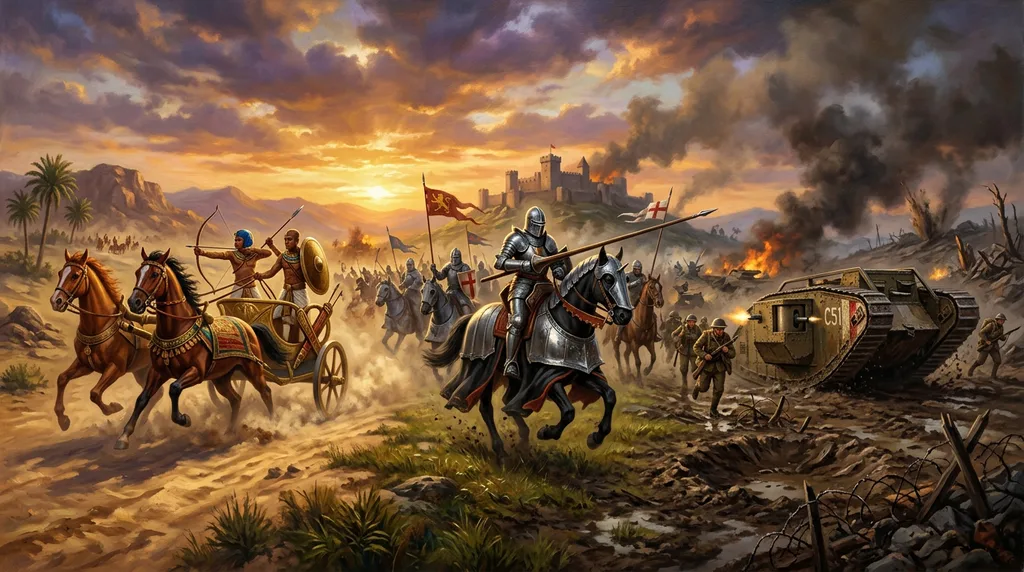
Cavalry began with the war chariot around 1700 BCE, passed to mounted riders on the Central Asian steppe by 900 BCE, reached its peak as the armoured knight between roughly 1000 and 1400, and stayed decisive on European battlefields through Napoleon. Rifles and machine guns ended the charge by 1918, and the tank, first used at the Somme in 1916, inherited the cavalry's job of breaking an enemy line.
Key takeaways
- The chariot was the first mobile weapon system, dominant from about 1700 BCE until riders replaced it around 900 BCE
- Steppe horse archers and heavily armoured cataphracts destroyed settled armies from Carrhae to Adrianople
- The stirrup, saddle and bred warhorse made the medieval knight, and disciplined infantry with pikes and bows unmade him
- Cavalry stayed decisive through Napoleon and useful through 1918 for scouting, screening and pursuit
- The tank took over the cavalry's shock role in 1916, and the helicopter took its scouting role fifty years later
The age of the chariot
The horse was domesticated on the Eurasian steppe around 3500 BCE, but early horses were too small to carry an armed man far, so the first mounted weapon was the two-wheeled chariot. Light, spoked-wheel chariots drawn by two horses appeared around 2000 BCE and by 1600 BCE every major power from Egypt to Mycenae was built around them. A chariot carried a driver and an archer or spearman, gave a firing platform that moved faster than any infantry, and cost as much to maintain as a small estate, which made the chariot warrior an aristocrat wherever he appeared.
The Battle of Kadesh in 1274 BCE, between Ramesses II of Egypt and the Hittites, is the largest chariot battle we know of, with perhaps 5,000 chariots on the field. Egyptian reliefs show the lighter Egyptian machines outmanoeuvring the heavier three-man Hittite ones. Chariots were limited to flat, open ground and were vulnerable once infantry learned to stand firm, and by around 900 BCE Assyrian armies were fielding true cavalry alongside them. Within three centuries the chariot had become a ceremonial vehicle.
Horse archers and cataphracts
Riding into battle began on the steppe, among peoples like the Scythians who lived on horseback and could shoot a composite bow at the gallop. Settled states adopted the horse more slowly. The Persians built a mixed cavalry of archers and lancers, and the Macedonian Companion cavalry under Alexander became the first shock cavalry in a Western army, deciding the battles of the Granicus, Issus and Gaugamela by charging at the point where the enemy line was weakest.
The steppe kept its edge. At Carrhae in 53 BCE the Parthians destroyed a Roman army of seven legions with horse archers who never closed to fight and cataphracts, riders and horses armoured head to foot, who charged when the Romans bunched together. At Adrianople in 378 CE Gothic cavalry caught a Roman army in the open and killed the emperor Valens. The Mongols in the thirteenth century took the steppe system to its limit, with every soldier mounted, several remounts per man and a discipline that let whole armies feint, retreat and turn on command. Their first serious defeat came at Ain Jalut in 1260, against Mamluk cavalry raised on the same methods.
- A steppe archer could carry a bow, a lance and 60 or more arrows and change horses without dismounting
- The cataphract was the ancestor of the armoured knight; the word means fully enclosed
- Rome eventually fielded cataphracts of its own, and its late army was far more cavalry-heavy than the republic's
The stirrup and the knight
Three things made the medieval knight: the stirrup, which reached Europe from the steppe by the eighth century and let a rider brace against the impact of a lance; the high-backed saddle, which held him in place; and centuries of selective breeding that produced destriers strong enough to carry a man in mail or plate. Add the couched lance, held rigid under the arm so that the full weight of horse and rider went into the point, and heavy cavalry could break any formation that did not hold absolutely firm.
The knight ruled the European battlefield from about the eleventh century. Norman cavalry wore down the English shield wall at Hastings in 1066, and French knights won at Bouvines in 1214. Maintaining a knight, with warhorses, armour, squires and land to pay for them, was so expensive that the feudal system is best understood as a long-term arrangement for financing heavy cavalry. That is also why the knight's eclipse was a social event as well as a military one. Scottish spearmen at Bannockburn in 1314, English longbowmen at Crecy in 1346 and Agincourt in 1415, and Swiss pike squares later in the century all showed that disciplined infantry on the right ground could stop a charge dead.
Cavalry in the gunpowder age
Firearms did not end cavalry; they changed its job. Sixteenth-century pistol-armed reiters tried to shoot their way through pike blocks, and mostly failed. The revival came from Gustavus Adolphus of Sweden, who told his horsemen at Breitenfeld in 1631 to charge home with the sword. The largest cavalry charge in European history was the Polish and Imperial attack led by Jan Sobieski that broke the Ottoman siege at Vienna in 1683.
Napoleon was the last commander to use cavalry as a decisive battlefield arm. His heavy cuirassiers and carabiniers were reserved to smash a wavering line, his light hussars and chasseurs scouted, screened and pursued, and his dragoons did a bit of everything. Murat's charge at Austerlitz and the massed attack at Friedland in 1807 won battles outright, while the ruinous charges at Borodino in 1812 and Ney's repeated attacks on the British squares at Waterloo showed the limits. Outside Europe, mounted samurai were cut down by massed arquebus fire at Nagashino in 1575, one of the first battles anywhere decided by infantry firearms.
- A Napoleonic army needed roughly one horse for every three soldiers, and forage often decided whether a campaign was possible
- The Charge of the Light Brigade at Balaclava in 1854 became the emblem of cavalry courage and cavalry futility against artillery
- Cavalry fought throughout the American Civil War, mostly as mounted infantry and raiders
The last charges
By 1914 the magazine rifle, the machine gun and quick-firing artillery had made the charge against unbroken infantry suicidal, but horses still gave something nothing else could: operational mobility. A mounted force could cover 50 kilometres a day where infantry managed 20, and every army in 1914 kept large cavalry arms for reconnaissance, screening and exploitation. In the open warfare of the Eastern Front and the Middle East they still had work. The Australian Light Horse charge that took Beersheba in October 1917 is usually counted as the last successful large cavalry charge, though Polish, Soviet and Italian cavalry all charged, sometimes successfully, in the Second World War.
The story that Polish lancers charged German tanks in September 1939 is a myth. At Krojanty, Polish cavalry successfully charged German infantry, were then caught by armoured cars, and the scene was written up by journalists brought to the site afterwards. Polish cavalry fought as mounted infantry throughout the campaign, as every cavalry arm had learned to do by then.
From horse to tank
The tank was invented to solve a specific problem: how to cross no man's land under fire and break a trench line. The first ones went into action at Flers-Courcelette during the Battle of the Somme in September 1916, and the first large-scale tank attack followed at Cambrai in 1917. Between the wars, theorists in Britain, Germany and the Soviet Union worked out that tanks, motorised infantry and aircraft together could do what heavy cavalry had once done, break a line and then exploit deep into the enemy rear before he could recover.
Germany applied it first, in Poland and France, and the Soviet Union then applied it back at far larger scale. The Battle of Kursk in 1943 involved several thousand tanks on each side and was followed by armoured offensives that carried the Red Army to Berlin. The lineage was acknowledged in the names: the units that became armoured regiments in most armies were the old cavalry regiments, and American armoured cavalry still wears the crossed sabres.
The horse as technology
It is easy to forget that the horse was itself the most important piece of military technology for nearly four thousand years, and that small changes in breeding and equipment had large consequences.
- Selective breeding produced both the massive destrier that could carry an armoured knight and the small, tireless steppe pony that let Mongol armies cover 100 kilometres a day
- The nailed horseshoe, in general use in Europe by the tenth century, protected hooves on stone and let cavalry operate on roads year round
- The horse collar, arriving from China, let horses pull heavy loads without choking and transformed the supply wagon
- Horse archery took a lifetime to learn, which is why steppe peoples produced cavalry that farming societies could rarely match
- Remounts were the limiting factor in every horse army; the Mongols brought several per man, and Napoleon lost more horses than men in Russia
What replaced cavalry, and what did not
The tank inherited the shock role and the helicopter, from the 1960s, inherited reconnaissance and rapid insertion, which was the old dragoon's job. Attack helicopters and armed drones now provide the mobile firepower that horse artillery once did. Two things were never fully replaced. One is the horse's ability to go where vehicles cannot, which is why American special forces rode with the Northern Alliance in Afghanistan in 2001. The other is symbolism. Horses remain the image armies reach for when they want to evoke tradition, and mounted units still lead state ceremonies in countries that have not fielded horse cavalry in a century. The horse left the battlefield; it never quite left the parade ground.
Test yourself
The mount is one of the best clues for dating a battle in the game. Chariots mean Egypt, the Hittites or Assyria. Unarmoured riders with bows point to the steppe. Fully armoured knights are medieval Europe. Plumed helmets and sabres are the Napoleonic era, and tanks put you in the twentieth century. Try the Battle encyclopedia or a round of Classic mode with that in mind.
Battles in this guide
Each links to its encyclopedia entry with the date, belligerents, result and further reading.
Battle of Kadesh
1274 BCE · Orontes River, Syria
Battle of Gaugamela
331 BCE · Gaugamela, Mesopotamia (modern Iraq)
Battle of Carrhae
53 BCE · Turkey/Syria
Battle of Adrianople
378 CE · Turkey
Battle of Hastings
1066 CE · England
Battle of Ain Jalut
1260 CE · Israel
Battle of Agincourt
1415 CE · France
Battle of Austerlitz
1805 CE · Czech Republic (Moravia)
Siege of Vienna (1683)
1683 CE · Vienna, Austria
Battle of the Somme
1916 CE · France
Common questions
When was the last cavalry charge in history?
The charge of the Australian Light Horse at Beersheba on 31 October 1917 is usually counted as the last successful large-scale one. Cavalry charged on a smaller scale in the Second World War, including Italian cavalry on the Eastern Front in 1942.
How did the stirrup change warfare?
It let a rider brace against the shock of impact, so a lance could be couched under the arm and driven home with the full weight of horse and rider. Combined with a high saddle and a bred warhorse, it made the armoured knight the dominant soldier in Europe for about four centuries.
When were tanks first used in battle?
On 15 September 1916 at Flers-Courcelette, during the Battle of the Somme. The first large tank attack was at Cambrai in November 1917. By 1940 armoured divisions had taken over the cavalry's role as the main mobile striking force.
Did Polish cavalry really charge German tanks in 1939?
No. At Krojanty on 1 September 1939 Polish cavalry charged and scattered German infantry, then withdrew under fire from armoured cars. Journalists shown the field afterwards produced the story, and German propaganda repeated it. Polish cavalry fought as mounted infantry.
Why did cavalry survive so long after rifles arrived?
Because horses still gave mobility nothing else could. A mounted force could move two or three times as fast as infantry until motor transport matured, so cavalry kept scouting, screening and pursuing long after the frontal charge had become suicidal.
Do modern armies still have cavalry?
In name, yes. Cavalry regiments in most armies are now reconnaissance or armoured units in vehicles or helicopters. A few ceremonial mounted units remain, and horses are occasionally used in terrain vehicles cannot cross, as in Afghanistan in 2001.
Sources and further reading
This guide was compiled from the works below and standard reference accounts. Battle pages linked in the text carry their own sources. Corrections are welcome via the contact details.
- Robert Drews, Early Riders: the origins of chariotry and riding
- Battle of Kadesh
- Stirrup: including the debate over how much the stirrup mattered
- Ann Hyland, The Medieval Warhorse: breeding, equipment and cost of the knight's horse
- Charge of the Light Brigade
- Battle of Beersheba (1917)
- Charge at Krojanty: the source of the Polish lancers myth
- Tanks in World War I
Can you name these battles from a picture?
Every battle in this guide is in the game. Try today's Daily Challenge or pick an era in Classic mode.