Guide
Women in Military History: Warriors, Leaders and Strategists
By Harry H, developer of BattleGuess · Published 25 March 2026 · Updated · 10 min read
Women have fought, commanded and planned in every era of military history. Artemisia captained warships at Salamis in 480 BCE, Boudica nearly drove Rome out of Britain in 60 CE, Zenobia conquered Egypt, Joan of Arc broke the siege of Orleans in 1429, and in the Second World War Soviet women flew bombers and served as snipers while women at Bletchley Park broke the German codes. Their record is far larger than most textbooks admit.
Key takeaways
- Women commanded armies and fleets in the ancient world, from Artemisia at Salamis to Boudica in Britain
- Joan of Arc broke the siege of Orleans at seventeen and turned the Hundred Years' War
- More than 800,000 Soviet women served in the Second World War, tens of thousands in combat
- Codebreaking, intelligence and resistance work by women was often the margin of victory
Ancient warriors and queens
The ancient record includes several women who held military command at the highest level. Artemisia I of Halicarnassus commanded her own squadron on the Persian side at Salamis and, according to Herodotus, was the only one of Xerxes' commanders to advise against fighting there. The British queen Boudica led a revolt against Roman rule in 60 or 61 CE that burned Colchester, London and St Albans before it was crushed. Cleopatra VII brought her own fleet to Actium in 31 BCE. Zenobia of Palmyra conquered Egypt and much of the Roman East in the 270s before Aurelian defeated her.
- Tomyris, queen of the Massagetae, defeated and killed Cyrus the Great in 530 BCE, according to Herodotus
- Tacitus puts the dead in Boudica's revolt at 70,000 to 80,000 Romans and provincials, though ancient figures are unreliable
- Archaeology on the Eurasian steppe has found armed women in a significant share of Scythian and Sarmatian warrior graves, the likely origin of the Greek Amazon legends
- Fu Hao, a consort of the Shang king Wu Ding around 1200 BCE, led armies according to oracle-bone inscriptions and was buried with weapons
Joan of Arc and medieval women at war
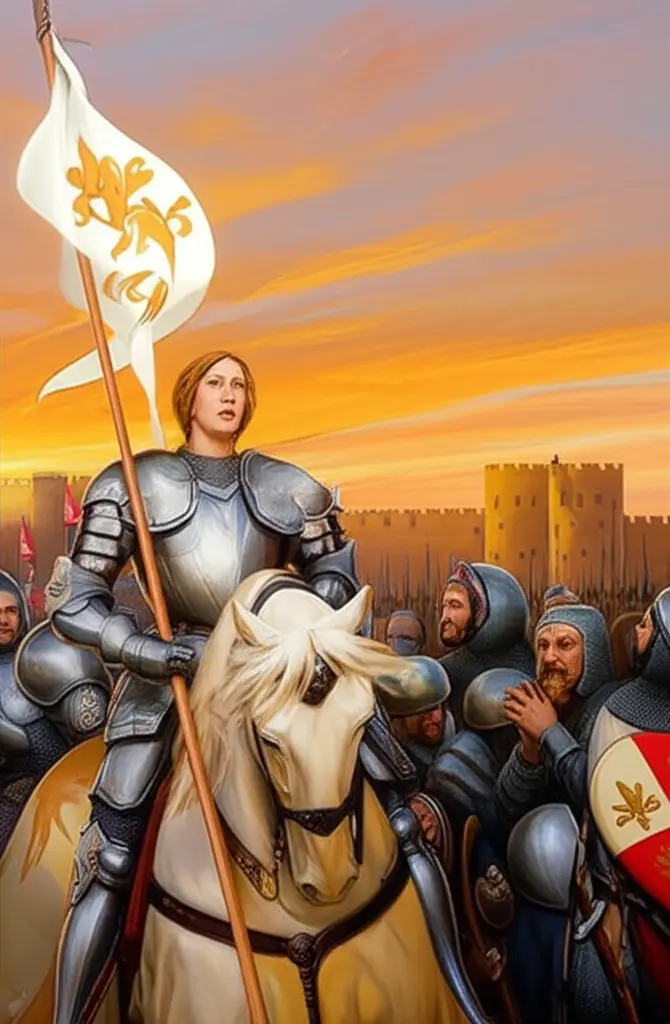
Joan of Arc is the most famous woman in Western military history. In 1429, aged about seventeen, she joined the demoralised French army at the siege of Orleans and within nine days the English had lifted a siege that had lasted seven months. Her leadership was both practical, in pressing for aggressive assaults, and symbolic, in restoring the belief that the Dauphin's cause could win. The campaign that followed took Charles VII to his coronation at Reims and turned the Hundred Years' War. Beyond Joan, medieval history is full of women who held castles under siege, raised and led troops in their husbands' absence, and ran the military affairs of their kingdoms.
Beyond the Western canon
The usual list of warrior women centres on Europe and the Mediterranean. Looking further afield produces a longer and more varied roll.
- Rani Lakshmibai of Jhansi led cavalry charges during the 1857 Indian Rebellion and died in action near Gwalior
- Trieu Thi Trinh led a rising against Chinese rule in third-century Vietnam and is remembered there as a national heroine
- Nzinga Mbande, queen of Ndongo and Matamba, fought Portuguese expansion in what is now Angola for three decades in the seventeenth century
- Ching Shih commanded a pirate confederation in the South China Sea in the early nineteenth century that, by contemporary accounts, ran to hundreds of ships
- The Agojie of Dahomey, an all-female regiment, fought through the nineteenth century and inflicted real defeats on French forces before the kingdom fell in 1892
- Lozen, an Apache warrior and strategist, fought alongside Victorio and Geronimo in the 1870s and 1880s
The Second World War
The Soviet Union fielded the largest force of women combatants in history. More than 800,000 served in the Red Army, tens of thousands in combat roles as snipers, machine-gunners, tank crew and pilots. Lyudmila Pavlichenko was credited with 309 kills as a sniper. The all-female 588th Night Bomber Regiment, the Night Witches, flew more than 23,000 sorties in slow wood-and-canvas biplanes. In Britain and the United States women were mostly kept out of combat but flew aircraft between factories and airfields, served in air defence, and went behind enemy lines for the Special Operations Executive.
After 1945 the story was uneven. The Soviet Union pushed most of its women veterans back into civilian life. Israel conscripted women from 1948 but restricted them to support roles for decades. The United States opened all combat roles to women only in 2015. Every military that has integrated women has worked through the same practical questions of training standards, unit cohesion and deployment, and the answers keep changing.
- Around three-quarters of the wartime staff at Bletchley Park were women, many operating the machines that broke Enigma traffic
- The SOE sent 39 women agents into occupied France; Virginia Hall was hunted by the Gestapo as one of the most dangerous Allied agents
- Women in the Soviet partisan movement served as couriers, saboteurs and fighters behind German lines
- The US Women Airforce Service Pilots ferried more than 12,000 aircraft during the war
Women behind the lines
Direct combat is only part of the picture. Intelligence, codebreaking, logistics, medicine and resistance work have often been where wars were actually decided, and in every conflict with detailed records women's share of that work turns out to be far larger than the battle narratives suggest. The Enigma decrypts that shaped the Battle of the Atlantic, the resistance networks that fed D-Day planners, and the field hospitals of every modern war all depended on women's labour and judgement.
Recognising their battles in the game
Several battles in the game are directly connected to women's command. A French army rallying under a banner at a besieged city is the siege of Orleans and Joan of Arc. An Egyptian fleet in the Ionian Sea is Actium and Cleopatra. Greek triremes in a narrow strait is Salamis, where Artemisia fought on the losing side and escaped by ramming one of her own allies. Find all three in the Battle Encyclopedia.
Battles in this guide
Each links to its encyclopedia entry with the date, belligerents, result and further reading.
Common questions
Did women fight in battles throughout history?
Yes. From Artemisia at Salamis and Boudica in Roman Britain to Joan of Arc at Orleans and Soviet snipers and pilots in the Second World War, women have fought and commanded in every era.
Who were the Night Witches?
The Soviet 588th Night Bomber Regiment, an all-female unit that flew more than 23,000 night sorties over the Eastern Front in obsolete Po-2 biplanes. German soldiers gave them the nickname.
What did Joan of Arc actually do in battle?
She joined the French army at Orleans in 1429, pushed the commanders into aggressive assaults on the English forts, was wounded leading one of them, and saw the siege lifted within nine days of her arrival. The campaign that followed turned the Hundred Years' War.
Were there really Amazon warriors?
Probably, though not as Greek myth described them. Excavations of Scythian and Sarmatian graves on the Eurasian steppe have found many women buried with weapons and bearing combat injuries. The Greek Amazon stories most likely grew from contact with these cultures.
How many women served in combat in the Second World War?
More than 800,000 Soviet women served in the Red Army, tens of thousands of them in combat roles as snipers, pilots, gunners and tank crew. The United States and Britain largely restricted women to auxiliary, ferrying and intelligence roles.
Who was the highest-ranking woman in military history?
It depends on the measure. Wu Zetian ruled Tang China as emperor and directed its armies in the seventh century. In modern terms, Ann Dunwoody became the first woman four-star general in the United States in 2008, and several countries now have women as chiefs of defence.
Sources and further reading
This guide was compiled from the works below and standard reference accounts. Battle pages linked in the text carry their own sources. Corrections are welcome via the contact details.
- Herodotus, The Histories: Artemisia and Tomyris
- Tacitus, Annals, Book 14: the fullest ancient account of Boudica's revolt
- Joan of Arc: the trial records make her one of the best documented people of the Middle Ages
- Night Witches (588th Night Bomber Regiment)
- Svetlana Alexievich, The Unwomanly Face of War: oral histories of Soviet women veterans
- Bletchley Park: the museum on the site of the wartime codebreaking centre
- Dahomey Amazons
Can you name these battles from a picture?
Every battle in this guide is in the game. Try today's Daily Challenge or pick an era in Classic mode.