Guide
Samurai Battles: The Warrior Conflicts of Feudal Japan
By Harry H, developer of BattleGuess · Published 6 February 2026 · Updated · 10 min read
The samurai battles that mattered most were Dan-no-ura in 1185, which ended the Genpei War and created the first shogunate; the repulse of the Mongol invasions in 1274 and 1281; Okehazama in 1560 and Nagashino in 1575, which announced Oda Nobunaga and the age of firearms; Sekigahara in 1600, which united Japan under the Tokugawa; and the siege of Osaka in 1615, which ended the last resistance to them.
Key takeaways
- The Genpei War of 1180 to 1185 created the shogunate, a military government that ruled Japan for seven centuries
- Typhoons wrecked two Mongol invasion fleets in 1274 and 1281 and gave Japanese the word kamikaze
- The Sengoku century produced Nobunaga, Hideyoshi and Tokugawa, and the massed firearms of Nagashino
- Sekigahara in 1600 unified Japan and began 250 years of peace under the Tokugawa
The warrior class of Japan
Japan's feudal centuries produced one of the most distinctive warrior cultures in history. The samurai began as mounted archers in the service of provincial lords and ended as a hereditary ruling class. Japanese warfare evolved from aristocratic single combat to mass infantry battles of a hundred thousand men or more, adopted gunpowder faster than most of Europe, and then, under the Tokugawa peace, froze the sword into a symbol of status. The romantic idea of the samurai owes a great deal to that final, peaceful period.
The Genpei War and the first shogunate
The Genpei War of 1180 to 1185 between the Taira and Minamoto clans established the pattern of military government that dominated Japan until 1868. It ended at sea at Dan-no-ura, in the straits of Shimonoseki, where the tide turned in the Minamoto's favour in the most literal sense: the current that had carried the Taira forward in the morning reversed and pinned them against the Minamoto arrows. The child emperor Antoku drowned with his grandmother, and Minamoto no Yoritomo became the first shogun.
The Mongol invasions
In 1274 and again in 1281 Kublai Khan sent fleets from Korea and China to conquer Japan. The first invasion, perhaps 30,000 strong, landed at Hakata Bay, fought for a day against samurai unused to massed archery and explosive bombs, then withdrew as a storm blew up. The second was far larger and was destroyed by a typhoon after weeks of fighting along the coastal wall the Japanese had built in the interval. The Japanese called the storms kamikaze, divine wind, and the memory shaped national identity for centuries.
- The invasions exposed samurai to coordinated infantry tactics, poisoned arrows and gunpowder bombs
- Japan built a stone wall along Hakata Bay after 1274 that the second invasion never got past
- The cost of the defence, with no conquered land to reward warriors, helped bring down the Kamakura shogunate
- Underwater archaeology at Takashima has recovered anchors, weapons and the remains of the 1281 fleet
The Sengoku century
From the 1460s to 1600 Japan fell apart into competing domains ruled by daimyo, the Sengoku or Warring States period. It produced the three unifiers, Oda Nobunaga, Toyotomi Hideyoshi and Tokugawa Ieyasu, and most of Japan's famous battles. At Okehazama in 1560 Nobunaga attacked the Imagawa camp in a thunderstorm and killed a lord with ten times his numbers. At Nagashino in 1575 his arquebusiers, firing from behind palisades, broke the Takeda cavalry. Between them, Takeda Shingen and Uesugi Kenshin fought five battles at Kawanakajima without a decision.
Survival pressure drove constant experiment. Armies grew from a few thousand retainers to conscript hosts of ashigaru foot soldiers armed with pikes and matchlocks. Daimyo copied each other relentlessly, and the winners were the generalists who combined cavalry, pike, firearms and siegecraft fastest.
Sekigahara and the Tokugawa peace
After Hideyoshi's death his generals split into two camps, and at Sekigahara in October 1600 roughly 160,000 men fought in the fog of a mountain valley. The battle was decided when Kobayakawa Hideaki, who had promised both sides his support, finally charged downhill into the Western Army's flank. Tokugawa Ieyasu became shogun three years later. The last resistance ended at the siege of Osaka in 1614 and 1615, where the Toyotomi heir died in the burning castle, and Japan then had no major battle for two and a half centuries.
Castles and siege warfare
Japanese castle design peaked in the late Sengoku and early Edo periods. Unlike the low, thick-walled European fortresses built to resist cannon, Japanese castles rose in tiers of stone bases and wooden towers, with winding approaches, false gates and multiple baileys designed to funnel attackers into fields of fire.
- Himeji Castle, a UNESCO World Heritage Site, is the finest surviving example
- Curved stone bases spread the weight of the towers and resisted earthquakes
- Osaka in 1614 was one of the largest sieges in Japanese history, with well over 200,000 men engaged
What samurai actually fought with
Popular culture puts the katana at the centre of samurai warfare, but the record does not. The original core skill of the warrior class was mounted archery, and the bow remained the prestige weapon through the Genpei War and the Mongol invasions. In the Sengoku period the spear did most of the killing, and after 1543 the matchlock arquebus, copied from Portuguese examples, was produced in Japan in greater numbers than in any European country. The sword was a sidearm and a badge of rank. It became the soul of the samurai only after the fighting stopped.
Bushido: myth and reality
The modern idea of bushido, an ancient unwritten code of absolute loyalty and ritual suicide, owes more to Meiji-era nationalism and Nitobe Inazo's 1900 book Bushido: The Soul of Japan than to how samurai behaved. Real warrior conduct varied by clan and century. Samurai changed sides when a cause looked lost, as Kobayakawa did at Sekigahara, negotiated ransoms, and used whatever weapon worked. Seppuku existed but was rare outside specific contexts. The accurate description of pre-modern samurai is a professional warrior class with a strong honour culture, not a brotherhood of self-sacrificing paragons.
Samurai warfare in world context
Set beside their contemporaries elsewhere, Japanese battles show surprising parallels.
- Early samurai fought much like the steppe horse-archers they eventually faced: bow first, sword last
- Sengoku pike-and-shot formations developed independently in the same decades as the Spanish tercio
- Japanese castles evolved upward with wooden towers while European fortresses went low and angular to resist artillery
- Sekigahara, with around 160,000 combatants, was as large as any European battle of its century
- The Tokugawa peace after 1615 lasted longer than almost any period of internal stability in a pre-modern state
Japanese battles in the game
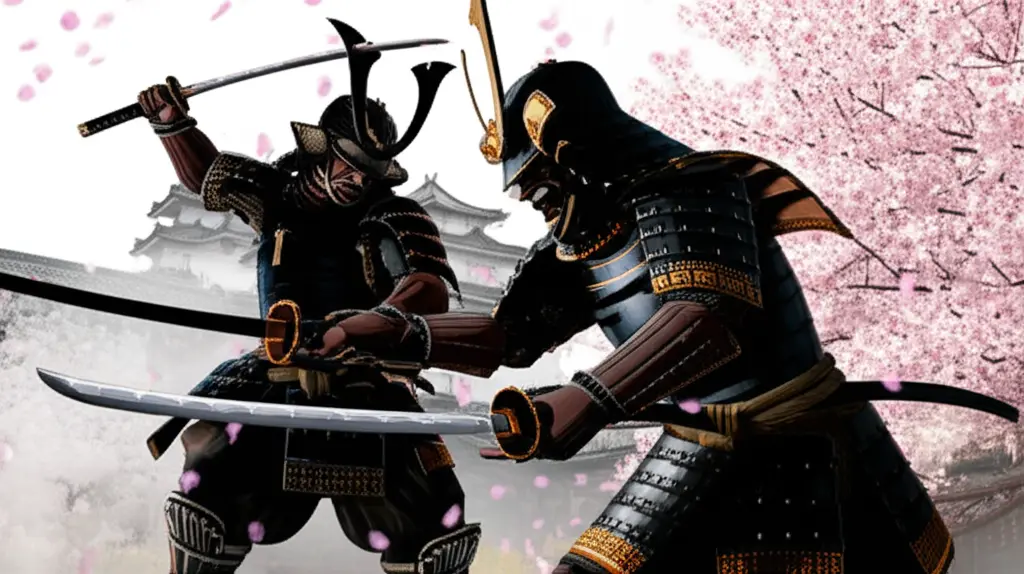
Japanese battles are among the most recognisable in the game's artwork: lamellar armour and crested helmets, castle walls with curved stone bases, and the shift from bow and spear to massed matchlocks in the late Sengoku scenes. Play the East Asia era in Classic mode or start with the Ambush and Surprise collection, which includes Okehazama.
Battles in this guide
Each links to its encyclopedia entry with the date, belligerents, result and further reading.
Battle of Dan-no-ura
1185 CE · Straits of Shimonoseki, Japan
Mongol Invasion of Japan
1274 CE · Hakata Bay, Japan
Battle of Okehazama
1560 CE · Okehazama, Owari, Japan
Battle of Kawanakajima
1561 CE · Kawanakajima, Nagano, Japan
Battle of Nagashino
1575 CE · Nagashino, Japan
Battle of Sekigahara
1600 CE · Sekigahara, Japan
Siege of Osaka
1615 CE · Osaka, Japan
Common questions
What was the most important samurai battle?
Sekigahara in 1600. Tokugawa Ieyasu's victory made him master of Japan, and the shogunate he founded kept the peace for more than 250 years.
What does kamikaze mean and where did the word come from?
Kamikaze means divine wind. It was the name given to the typhoons that wrecked the Mongol invasion fleets of 1274 and 1281, which the Japanese took as a sign of divine protection. The word was reused for suicide pilots in 1944.
Did samurai use guns?
Yes, and in large numbers. Matchlock arquebuses arrived with the Portuguese in 1543, and by the 1570s Japanese smiths were producing them by the thousand. Nagashino in 1575 showed what massed volleys from behind field defences could do to cavalry.
Were there female samurai?
Women of the warrior class, sometimes called onna-musha, trained with the naginata and were expected to defend households and castles. Tomoe Gozen fought in the Genpei War, and women commanded garrisons during the Sengoku period.
What weapons did samurai use most?
The bow in the early period and the spear in the Sengoku. The sword was a sidearm and a mark of rank. Mounted archery, not swordsmanship, was the original defining skill of the class.
What ended the age of the samurai?
The Meiji Restoration of 1868 dismantled the feudal order and the samurai class was abolished in the 1870s. The Satsuma Rebellion of 1877, in which a conscript army with modern weapons defeated the last major samurai rising, closed the era militarily.
Sources and further reading
This guide was compiled from the works below and standard reference accounts. Battle pages linked in the text carry their own sources. Corrections are welcome via the contact details.
- Stephen Turnbull, The Samurai Sourcebook and War in Japan 1467 to 1615: the most accessible English-language surveys of samurai warfare
- The Tale of the Heike: the medieval epic of the Genpei War, including Dan-no-ura
- Mongol invasions of Japan
- Sengoku period
- Battle of Sekigahara
- Nitobe Inazo, Bushido: The Soul of Japan (1900): the book that shaped the modern myth
Can you name these battles from a picture?
Every battle in this guide is in the game. Try today's Daily Challenge or pick an era in Classic mode.