Guide
The Latin American Wars of Independence
By Harry H, developer of BattleGuess · Published 2 March 2026 · Updated · 13 min read
The Latin American wars of independence ran from 1810 to 1825 and freed every Spanish colony on the American mainland. Jose de San Martin won the south with the crossing of the Andes and the battles of Chacabuco and Maipu. Simon Bolivar won the north at Boyaca, Carabobo and Pichincha. Their armies met in Peru, where Antonio Jose de Sucre finished the war at Ayacucho in December 1824.
Key takeaways
- Napoleon's occupation of Spain in 1808 removed the king and gave the colonies a reason and an excuse to govern themselves
- San Martin freed Argentina and Chile from the south, crossing the Andes in 1817 to win at Chacabuco and Maipu
- Bolivar freed Venezuela, Colombia and Ecuador from the north, with Boyaca in 1819 the decisive stroke
- Ayacucho in December 1824 destroyed the last royalist army and ended Spanish rule on the mainland
- Puebla in 1862, remembered as Cinco de Mayo, belongs to a later war against France, not to independence
Why the empire broke
By 1800 Spain had ruled most of the Americas for nearly three centuries. The colonies were run by officials sent from Spain, trade was restricted to Spanish ports, and the American-born elite, the Creoles, were shut out of the highest offices. The American and French revolutions had shown that empires could be overthrown, and Haiti's slave revolt, complete by 1804, had shown it could happen in the Caribbean.
The trigger came from Europe. In 1808 Napoleon invaded Spain, forced King Ferdinand VII to abdicate and put his own brother on the throne. Across the Americas, town councils argued that with no legitimate king there was no legitimate authority over them, and set up governing juntas of their own. Most began by claiming loyalty to the captive Ferdinand. Within two years the juntas in Caracas, Buenos Aires, Bogota and Santiago had become independence movements, and when Ferdinand returned in 1814 and sent an army to restore the old order, the argument became a war.
- The Peninsular War in Spain tied down the troops that might otherwise have held the colonies
- Mexico's rising began in 1810 under the priest Miguel Hidalgo and was crushed within a year; independence there came in 1821 by a different route
- Brazil separated from Portugal in 1822 almost without fighting, because the Portuguese royal family had been living in Rio since 1808
The south: Belgrano, San Martin and the crossing of the Andes
Buenos Aires declared its own government in May 1810 and never lost control of the Rio de la Plata, but its early armies were beaten whenever they marched north toward the royalist stronghold of Upper Peru, modern Bolivia. Manuel Belgrano's victory at Tucuman in September 1812 saved the revolution in the north-west, and in 1813 a former Spanish officer, Jose de San Martin, won his first action at San Lorenzo with a newly raised regiment of mounted grenadiers.
San Martin drew the strategic conclusion that shaped the rest of the war: Upper Peru could not be taken from the south, so Spanish power had to be attacked at its centre, in Lima, by sea. That meant taking Chile first. Chile's own independence movement had been crushed at Rancagua in 1814, and its survivors fled over the mountains to Mendoza, where San Martin spent two years building the Army of the Andes. He set up foundries and workshops, bred mules, planted crops, ran a network of agents inside Chile and fed the royalists false information about which pass he would use.
Chacabuco and Maipu, 1817 to 1818
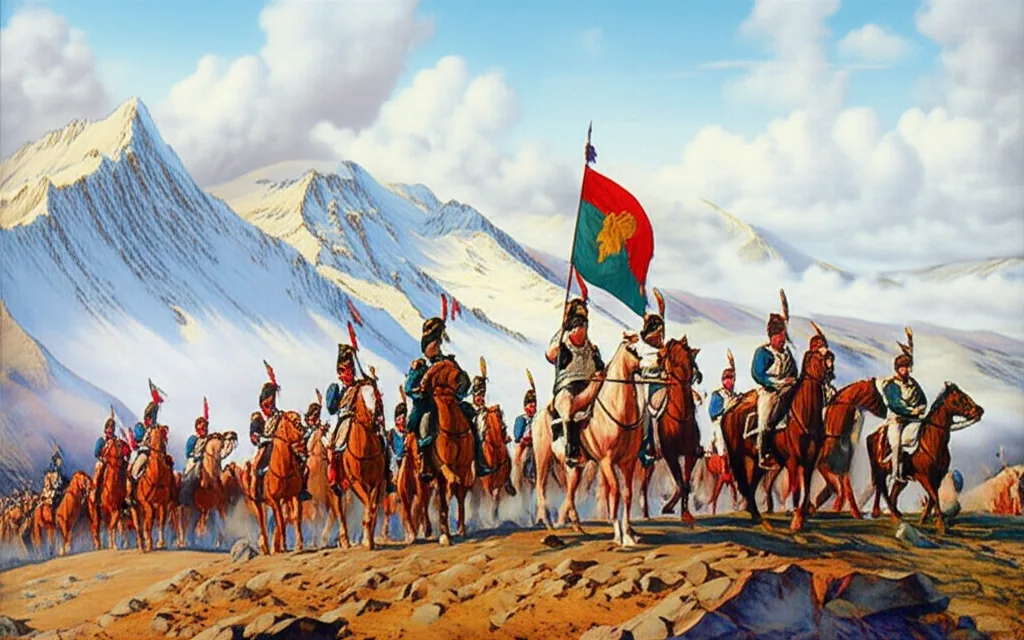
In January 1817 about 5,000 soldiers crossed the Andes in several columns through passes above 3,500 metres, in midsummer but still through snow. Roughly a third of the horses and mules died. Twelve days later, on 12 February, the army came down into the central valley and beat the royalists at Chacabuco, and Santiago fell the next day. Bernardo O'Higgins became Supreme Director of Chile and independence was declared on the first anniversary of the battle.
The royalists were not finished. Reinforced from Peru, they surprised and scattered the patriot army in a night attack at Cancha Rayada in March 1818. San Martin and O'Higgins rallied what was left and, on 5 April, destroyed the royalist army at Maipu in the decisive battle for Chile. The famous embrace of the two commanders on the field is one of the founding images of both countries. With Chile secure, San Martin built a fleet under the Scottish admiral Thomas Cochrane and in 1820 sailed for Peru.
- The Andes crossing is regularly compared with Hannibal's crossing of the Alps; it covered a higher range with a larger army
- Chacabuco was won largely by O'Higgins's impatient frontal attack, which San Martin had not ordered
- Maipu cost the royalists about 2,000 dead and 2,000 prisoners, roughly their entire army in Chile
The north: Bolivar from Boyaca to Carabobo
Simon Bolivar came from one of the richest families in Caracas and spent the first decade of the war losing. Two Venezuelan republics collapsed under him, in 1812 and 1814, and he twice went into exile in the Caribbean. From 1817 he rebuilt his cause in the Orinoco plains, where the llanero horsemen under Jose Antonio Paez gave him a cavalry arm and the river gave him a supply line.
In 1819 he did what nobody expected. Instead of fighting for Venezuela, he marched his army west through flooded plains and over the Andes at more than 4,000 metres, in the rainy season, into the royalist heartland of New Granada. The army arrived starving and half-equipped, but the Spanish had nothing in its path. On 7 August 1819 Bolivar cut off and destroyed the only royalist field army at Boyaca. Bogota fell three days later, and with it the treasury and the arms he needed. Two years after that, on 24 June 1821, he beat the main Spanish army in Venezuela at Carabobo, and Caracas was his for good.
- The British Legions, several thousand veterans of the Napoleonic Wars, fought at Boyaca and Carabobo and were praised by Bolivar as the saviours of his country
- Boyaca lasted about two hours and cost the patriots fewer than 100 casualties; nearly the whole royalist force was captured
- Gran Colombia, the union of Venezuela, New Granada and Ecuador that Bolivar founded, lasted only until 1831
Pichincha and the meeting at Guayaquil, 1822
Bolivar sent his best general, the 26-year-old Antonio Jose de Sucre, south to Ecuador. On 24 May 1822 Sucre defeated the royalists on the slopes of the volcano above Quito at Pichincha, fought at nearly 3,500 metres, and Ecuador joined Gran Colombia. Two months later Bolivar and San Martin met in Guayaquil. San Martin held Lima but could not finish the royalists in the Peruvian highlands. What was said at the meeting has never been settled, but the result was clear: San Martin resigned his command, left Peru and eventually South America, and spent the rest of his life in Europe. Bolivar took over the war.
Junin and Ayacucho, 1824
The last royalist armies were in the Peruvian Andes, and Bolivar spent 1823 and early 1824 rebuilding a force to reach them. On 6 August 1824 the two cavalries met on the high plain of Junin in a battle fought entirely with lance and sabre, without a shot being fired, which the patriots won. Bolivar then handed the army to Sucre and went to Lima.
On 9 December 1824, at Ayacucho, Sucre's 5,800 men faced about 9,000 royalists under the viceroy Jose de la Serna on a plain at 3,300 metres. Sucre attacked first, broke the royalist left with cavalry and rolled up the line within an hour. La Serna was wounded and captured, and his second-in-command signed a capitulation that surrendered every remaining Spanish garrison in Peru. Upper Peru followed in 1825 and named itself Bolivia. Ayacucho was the last major battle of the wars and ended three centuries of Spanish rule on the American mainland.
- Many of the senior royalist officers at Ayacucho were themselves Peruvian-born, and most of the rank and file were Andean conscripts
- The capitulation was generous: royalist officers were allowed to return to Spain at Peru's expense
- Spain did not recognise Peruvian independence until 1879
Mexico, Puebla and the myth of Cinco de Mayo
Mexico's independence came in 1821 when the royalist officer Agustin de Iturbide changed sides and led the army into Mexico City with barely a fight. The battle most people associate with Mexican freedom happened forty years later. In 1862 a French army sent by Napoleon III to install a European emperor was defeated outside the city of Puebla by a smaller Mexican force under Ignacio Zaragoza. The Battle of Puebla on 5 May 1862 did not stop the French, who took the city the following year and ruled through the Emperor Maximilian until 1867. It is celebrated as Cinco de Mayo because a badly equipped republican army had beaten what was then considered the best army in Europe. Mexico's actual independence day is 16 September.
What independence did not change
Bolivar died in 1830 on his way into exile, having written that whoever served a revolution ploughed the sea. The wars had freed the continent from Spain but had not produced the united republic he wanted. Gran Colombia split into Venezuela, Colombia and Ecuador in 1831. The Creole elite replaced Spanish officials at the top and kept most of the old land and labour system beneath them. Enslaved people and indigenous soldiers had fought on both sides, often on promises of freedom or land, and most of those promises were slow to be kept. Strongman rule, civil war and dependence on British capital shaped the first century of the new republics.
A second round of wars then fixed the borders. The War of the Triple Alliance, which ended at Cerro Cora in 1870, killed a large share of Paraguay's population. The War of the Pacific, decided at sea at Angamos and on land at Arica, left Bolivia without a coastline. The Chaco War of the 1930s was the last major war between South American states.
Test yourself
The South American battles are among the newest in the game and among the hardest to place, because uniforms of the 1810s and 1820s look much like Napoleonic Europe. Look for the terrain: high Andean passes, volcanic slopes and open plains are the giveaways. Find all of them in the Battle encyclopedia or take on the era in Classic mode.
Battles in this guide
Each links to its encyclopedia entry with the date, belligerents, result and further reading.
Battle of Tucuman
1812 CE · Tucuman, Argentina
Battle of San Lorenzo
1813 CE · San Lorenzo, Argentina
Battle of Chacabuco
1817 CE · Chacabuco, Chile
Battle of Maipu
1818 CE · Maipu, Chile
Battle of Boyaca
1819 CE · Boyaca, Colombia
Battle of Carabobo
1821 CE · Carabobo, Venezuela
Battle of Pichincha
1822 CE · Quito, Ecuador
Battle of Junin
1824 CE · Junin, Peru
Battle of Ayacucho
1824 CE · Ayacucho, Peru
Battle of Puebla
1862 CE · Puebla, Mexico
Common questions
Who was Simon Bolivar?
A Venezuelan-born general and politician who led the independence of Venezuela, Colombia, Ecuador, Peru and Bolivia between 1813 and 1825. His decisive victories were Boyaca in 1819 and Carabobo in 1821. Bolivia is named after him.
What triggered the Latin American wars of independence?
Napoleon's invasion of Spain in 1808 and the removal of King Ferdinand VII. With no legitimate king, colonial towns set up their own governing juntas, and when Spain tried to restore control after 1814 the juntas fought for full independence.
What was the most important battle of the wars?
Ayacucho, on 9 December 1824, where Sucre destroyed the last royalist army in Peru and forced the surrender of every remaining Spanish garrison. Boyaca in 1819 and Maipu in 1818 were decisive for the north and south respectively.
What does Cinco de Mayo celebrate?
The Battle of Puebla on 5 May 1862, when a Mexican army defeated a French invasion force. It is not Mexican independence day, which is 16 September and marks the start of the 1810 rising.
Why did Brazil's independence look so different?
The Portuguese royal family fled Napoleon to Rio de Janeiro in 1808 and ran the empire from Brazil. When the king went home in 1821, his son Pedro stayed, declared independence in 1822 and became emperor. There was fighting in the north-east, but nothing like the fifteen-year war in Spanish America.
Why did Gran Colombia break apart?
Distance, poor communications, regional rivalry and disagreement over whether the union should be centralised or federal. Bolivar's attempt to hold it together as a strongman failed, and by 1831 it had split into Venezuela, Colombia and Ecuador.
Sources and further reading
This guide was compiled from the works below and standard reference accounts. Battle pages linked in the text carry their own sources. Corrections are welcome via the contact details.
- John Lynch, The Spanish American Revolutions 1808-1826: the standard single-volume history of the wars
- John Lynch, Simon Bolivar: A Life: the best modern biography in English
- Jose de San Martin
- Crossing of the Andes: the logistics of the 1817 campaign
- Battle of Ayacucho
- Guayaquil Conference: what is and is not known about the Bolivar and San Martin meeting
- Battle of Puebla
Can you name these battles from a picture?
Every battle in this guide is in the game. Try today's Daily Challenge or pick an era in Classic mode.