Guide
The Turning Points of World War II
By Harry H, developer of BattleGuess · Published 29 January 2026 · Updated · 13 min read
The turning points of World War II were the battles after which one side could no longer realistically win: the Battle of Britain in 1940, Moscow in 1941, Midway and El Alamein in 1942, Stalingrad in early 1943, Kursk that summer and the Normandy landings in June 1944. No single battle decided the war. Together they moved the initiative from the Axis to the Allies in about four years.
Key takeaways
- The Battle of Britain in 1940 was the first German defeat and kept an Allied base in Western Europe
- Moscow in December 1941 ended the possibility of a quick German victory in the east
- Midway in June 1942 cost Japan four fleet carriers and the initiative in the Pacific
- Stalingrad and Kursk, between November 1942 and July 1943, broke the Wehrmacht on the Eastern Front
- D-Day opened the second front that ended the war in the west within eleven months
What makes a turning point?
The Second World War killed somewhere between 70 and 85 million people and was fought on every ocean and on four continents. Within that vast conflict a small number of battles stand out as moments when the momentum shifted for good. A turning point is not the bloodiest battle or the most dramatic victory. It is the engagement after which one side could no longer win, whether or not anyone realised it at the time.
Historians argue about which battles qualify, and the argument itself is useful. The traditional Western list is Britain, Midway, El Alamein, Stalingrad and D-Day. Historians of the Eastern Front add Moscow and Kursk, and point out that roughly four in five German soldiers killed in the war died fighting the Soviet Union. This guide takes both views seriously and gives seven battles, in order, with a short note on what each one changed.
- A turning point removes a realistic path to victory for one side
- It usually follows a run of success for the loser, which is why it is often not recognised at once
- It matters for what came after it, not for how many people it killed
1. The Battle of Britain, July to October 1940
After the fall of France in June 1940 Britain stood alone in Western Europe. The Luftwaffe was ordered to destroy the Royal Air Force so that a seaborne invasion, Operation Sea Lion, could cross the Channel. The Battle of Britain was the first campaign in history fought entirely in the air, and Germany lost it. Fighter Command was directed by the Chain Home radar network and a control system that put its squadrons in the right place, and it was outproducing the Luftwaffe in fighters by the autumn.
The result was the first clear German defeat of the war. Hitler postponed the invasion in September and never revived it. Britain survived as the base from which the bombing campaign, the Atlantic convoys and, eventually, the Normandy landings were all mounted. Churchill's line that never was so much owed by so many to so few was a tribute to about three thousand aircrew, of whom around one in five were killed.
- Fighter Command lost about 1,000 aircraft and the Luftwaffe about 1,900 between July and October 1940
- Radar and the Dowding control system mattered more than any single aircraft type
- The Blitz that followed killed more than 40,000 British civilians but did not break civilian morale
- The Dunkirk evacuation in May and June, covered in the Battle of Dunkirk, had saved the army that now defended the coast
2. Moscow, October 1941 to January 1942
Operation Barbarossa, launched in June 1941, was built on the assumption that the Soviet Union would collapse in a single campaign. By late autumn German spearheads were within sight of Moscow, and the capital's government departments had been evacuated. Then the weather, exhaustion and stiffening resistance stopped the advance, and on 5 December the Red Army counter-attacked with fresh divisions from Siberia. The Wehrmacht was pushed back between 100 and 250 kilometres and suffered its first strategic defeat on land.
Moscow is the turning point most often left off Western lists, and the case for it is strong. It ended the only German plan that could have won the war in the east: a quick knockout before Soviet industry, evacuated beyond the Urals, could recover. From January 1942 Germany was committed to a long war against an enemy with more people, more oil and, within a year, more tanks. The siege of Leningrad, which began the same autumn and lasted 872 days, showed how much the Soviet state was prepared to endure.
3. Midway, June 1942
Six months after Pearl Harbor the Japanese navy set out to capture Midway Atoll and draw the remaining American carriers into a decisive battle. American codebreakers had read enough of the Japanese naval cipher to know the target, the date and the rough order of battle, and Admiral Nimitz placed three carriers in ambush. On the morning of 4 June, at the Battle of Midway, American dive-bombers caught the Japanese carriers with their decks full of fuelled and armed aircraft. Four fleet carriers were sunk in a single day, along with the trained aircrews Japan could not replace.
Midway did not end Japanese offensive operations at once, but it removed the margin of carrier superiority Japan had enjoyed since December 1941. The Coral Sea a month earlier had already blunted one Japanese advance. After Midway the United States could begin the long counter-offensive at Guadalcanal, and American shipyards guaranteed that the balance would only get worse for Japan. It also settled an argument about naval power: the aircraft carrier, not the battleship, now decided command of the sea.
- Japan lost the carriers Akagi, Kaga, Soryu and Hiryu; the United States lost the Yorktown
- The intelligence breakthrough came from the cryptanalysts of Station Hypo in Hawaii
- Japanese carrier losses could not be replaced for two years; American losses were replaced within months
4. El Alamein, October to November 1942
In the summer of 1942 Rommel's Panzer Army Africa had chased the British Eighth Army back to a defensive line sixty miles from Alexandria. The Second Battle of El Alamein was Montgomery's set-piece answer: a twelve-day battle of minefields, artillery and attrition that broke the Axis line and began a retreat that ended in Tunisia six months later. The Anglo-American landings in Morocco and Algeria, Operation Torch, followed within days.
El Alamein is the smallest battle in this guide, and some historians question whether it belongs here at all. Its importance was political and strategic rather than a matter of scale. It secured the Suez Canal and Middle Eastern oil, it was the first clear British land victory over German forces, and it made Italy the next Allied target. Churchill's judgement that before Alamein there was never a victory and after it never a defeat is generous but not far wrong for the British army in the west.
5. Stalingrad, August 1942 to February 1943
The Battle of Stalingrad was the bloodiest battle in history, with combined casualties usually estimated at between 1.5 and 2 million. The German Sixth Army fought its way into the city through the autumn of 1942, taking most of it building by building. On 19 November the Soviet counter-offensive, Operation Uranus, struck the Romanian and Italian armies guarding the German flanks and closed a ring around about 300,000 Axis troops in four days. Hitler forbade a breakout. Field Marshal Paulus surrendered on 31 January 1943 and the last pocket gave up two days later.
What made Stalingrad decisive was not only the loss of an entire field army but the end of any German claim to the initiative in the east. After Stalingrad the Wehrmacht could still win battles, but it could no longer choose where the war would be fought. Germany's allies drew their own conclusions: Romania, Hungary and Italy all began looking for a way out, and the myth of German invincibility that had held occupied Europe quiet since 1940 was broken.
- Operation Uranus was aimed at the weakly equipped Romanian armies on the flanks, not at the Sixth Army itself
- The Luftwaffe airlift promised to supply the pocket delivered a fraction of what was needed
- Paulus was the first German field marshal ever to surrender; Hitler had promoted him expecting suicide
- The Soviet victory was announced with three days of national mourning in Germany
6. Kursk, July 1943
Germany's last major offensive in the east was aimed at a bulge in the Soviet line around Kursk. Soviet intelligence knew the plan months in advance, and the Red Army built defensive belts up to 150 kilometres deep, with minefields, anti-tank guns and reserves behind them. The Battle of Kursk opened on 5 July and the German attack was stopped within a week. The Soviet counter-offensives that followed took Orel, Belgorod and Kharkov by the end of August.
Kursk confirmed what Stalingrad had begun. It was the first time a German summer offensive had failed outright, and after it the Wehrmacht never again attacked at strategic scale on the Eastern Front. The tank battle at Prokhorovka on 12 July, long described as the largest in history, was smaller and more one-sided than the legend suggests, but the campaign as a whole was a clear Soviet victory. From August 1943 the Red Army held the initiative continuously until it reached the Reichstag in Berlin.
7. Normandy, June 1944
D-Day, 6 June 1944, was the largest amphibious operation in history. About 156,000 Allied troops landed on five beaches on the first day, supported by 7,000 ships and landing craft and more than 11,000 aircraft. The deception plan, Operation Bodyguard, kept the German Fifteenth Army waiting for a second landing near Calais for weeks. Artificial Mulberry harbours let the Allies land supplies without capturing a port. The battle for Normandy that followed lasted until late August and ended with the German armies in France broken.
D-Day was a turning point because it made the outcome of the war in the west a matter of time. Germany now had to fight three fronts at once, in France, in Italy and in the east, where the Soviet Operation Bagration destroyed Army Group Centre in the same month. The failed airborne gamble at Arnhem in September and the German counter-offensive in the Ardennes in December delayed the end, but neither changed it. Berlin fell eleven months after the landings.
- Omaha Beach saw the heaviest fighting, with over 2,000 American casualties on the first day
- Two American and one British airborne division landed overnight to hold the flanks
- Bagration, launched on 22 June, cost Germany more men than Stalingrad
The turning points that are often left out
Seven battles is already a long list, but several other campaigns have a claim.
- The Battle of the Atlantic, 1939 to 1945: the convoy war decided whether Britain could be supplied at all; the U-boats were beaten in May 1943
- Guadalcanal, August 1942 to February 1943: six months of land, sea and air fighting that drained Japan of pilots and destroyers it could not replace
- Tobruk, 1941: the eight-month siege held Rommel short of Egypt for most of a year
- The Italian campaign, 1943 to 1945: Monte Cassino and the rest of the slow advance up Italy tied down German divisions that could have gone to France
- Leyte Gulf, October 1944: the largest naval battle of the war finished the Japanese navy as a fighting force
Home fronts and intelligence
Every turning point above depended on things that happened far from the battlefield. American factories built more aircraft in 1944 alone than Germany and Japan produced during the whole war. The Soviet Union moved more than 1,500 factories east of the Urals in 1941 and had them producing T-34s while the front was collapsing. British scientists produced radar, operational research and the codebreaking operation at Bletchley Park, whose Ultra) decrypts shaped the Atlantic and North African campaigns. American cryptanalysts reading Japanese naval traffic made Midway possible. Take away any of these and the battles look very different, or do not happen at all.
Test yourself
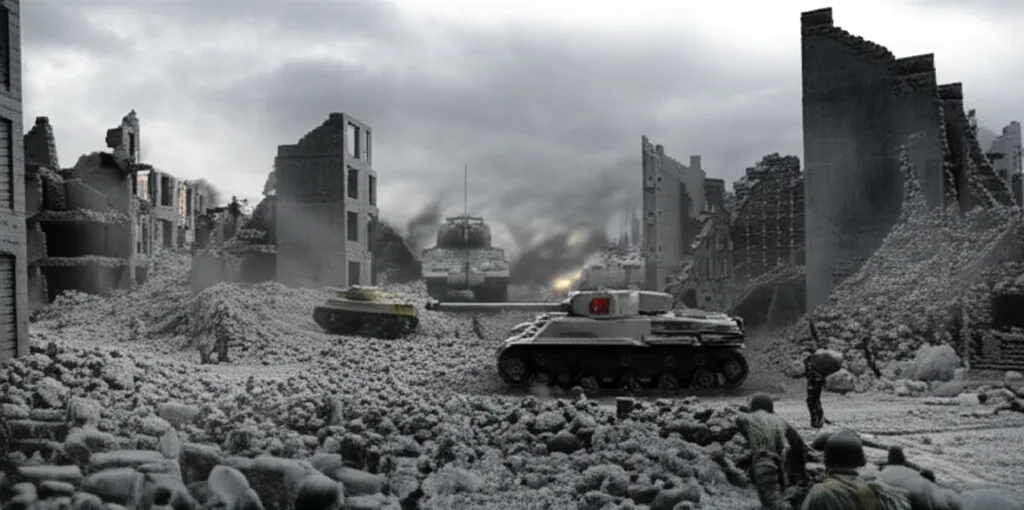
All seven turning points are in the game, and the modern-era scenes are among the easiest to date from the artwork: aircraft, tanks and ruined cities are hard to mistake for anything earlier. Try Classic mode and see how many you can name, or browse the Battle encyclopedia first.
Battles in this guide
Each links to its encyclopedia entry with the date, belligerents, result and further reading.
Battle of Britain
1940 CE · United Kingdom
Battle of Stalingrad
1943 CE · Soviet Union (Russia)
Battle of Midway
1942 CE · Pacific Ocean
Battle of El Alamein
1942 CE · Egypt
Battle of Kursk
1943 CE · Soviet Union (Russia)
D-Day
1944 CE · Normandy, France
Battle of Guadalcanal
1942 CE · Solomon Islands
Siege of Leningrad
1941 CE · Soviet Union (Russia)
Battle of Dunkirk
1940 CE · France
Battle of Berlin
1945 CE · Germany
Common questions
What was the turning point of World War II?
There was no single one. The Battle of Britain in 1940 kept Britain in the war, Moscow in 1941 ended the chance of a quick German victory, Midway in 1942 turned the Pacific, and Stalingrad and Kursk in 1943 broke the German army in the east. D-Day in 1944 made the end in the west a matter of time.
Was Stalingrad or Kursk the bigger turning point?
They were linked rather than alternatives. Stalingrad destroyed a German field army and ended German control of where the war in the east was fought. Kursk, six months later, confirmed it by stopping the last German strategic offensive within a week. After Kursk the Wehrmacht only reacted to Soviet attacks.
How many people died at Stalingrad?
Estimates for combined military and civilian casualties usually fall between 1.5 and 2 million, which makes it the bloodiest battle in history. About 91,000 Axis soldiers surrendered in February 1943, and only a small fraction of them survived captivity.
Why was D-Day so important?
It opened a second front in Western Europe that Germany could not hold while also fighting the Soviet Union and the Allied armies in Italy. Once the Allies were ashore in strength and supplied through the Mulberry harbours, the war in the west became a matter of time.
How did code-breaking affect these battles?
Enormously. British Ultra intelligence from Enigma decrypts helped win the Battle of the Atlantic and informed the North African campaign, while American cryptanalysts reading Japanese naval codes told Nimitz where and when the Japanese fleet would appear at Midway.
Why is the Eastern Front underrepresented in Western histories?
Cold War politics, language barriers and the fact that most early English-language accounts came from Western veterans and German generals. Roughly 80 percent of German military deaths were on the Eastern Front, and Soviet deaths, military and civilian, are usually put at more than 25 million.
Sources and further reading
This guide was compiled from the works below and standard reference accounts. Battle pages linked in the text carry their own sources. Corrections are welcome via the contact details.
- Richard Overy, Why the Allies Won: the clearest single-volume argument about what decided the war
- Antony Beevor, Stalingrad: the standard narrative history of the battle
- David Glantz and Jonathan House, When Titans Clashed: the Eastern Front from Soviet as well as German sources
- Jonathan Parshall and Anthony Tully, Shattered Sword: Midway from the Japanese side; corrects many older accounts
- Imperial War Museums: the Battle of Britain
- The National WWII Museum, New Orleans: timelines, articles and oral histories
- Normandy landings
Can you name these battles from a picture?
Every battle in this guide is in the game. Try today's Daily Challenge or pick an era in Classic mode.