Guide
How Ancient Warfare Shaped the Modern World
By Harry H, developer of BattleGuess · Published 18 November 2025 · Updated · 12 min read
Ancient warfare shaped the modern world in four ways. It created the state, because paying and feeding an army required taxation, writing and administration. It produced the drilled infantry and combined-arms tactics that armies still teach. It built Roman roads, cities and law across Europe. And it spread technology, language and religion along the routes that conquering armies opened.
Key takeaways
- The first organised armies in Sumer and Egypt required taxation, record-keeping and a bureaucracy, which is where the state comes from
- The Greek phalanx showed that drilled citizen infantry could beat far larger armies, and the Macedonian version conquered Persia
- Roman roads, camps, law and citizenship were military tools that became the infrastructure of Europe
- War spread iron, the stirrup, the crossbow and gunpowder faster than trade ever did
- Modern borders, languages and legal systems still follow the lines drawn by ancient conquests
The birth of organised warfare
The earliest battles we can name were fought in Mesopotamia and Egypt more than four thousand years ago, and they already show the pattern that would define warfare for millennia. The Stele of the Vultures, carved in Sumer around 2450 BCE, shows infantry advancing in a tight block with overlapping shields and levelled spears. That is a phalanx, two thousand years before the Greeks perfected it. Egyptian pharaohs fought the first battles for which we have a detailed narrative, at Megiddo in 1457 BCE and Kadesh in 1274 BCE, and both were built around the chariot, the first mobile strike weapon.
These armies could not exist without a state behind them. Someone had to count the soldiers, store the grain, cast the bronze and record who had been paid. Cuneiform writing, standardised weights and the first tax registers all grew up around the needs of temples and armies. The Assyrian empire, whose sieges at Lachish and elsewhere are carved in stone reliefs, ran the first professional standing army and the road and courier network to move it. The modern state, with its bureaucracy and its monopoly on organised force, begins here.
- The Battle of Kadesh produced the world's first surviving peace treaty, between Egypt and the Hittites
- Assyrian armies of the eighth century BCE combined siege engineers, cavalry, archers and heavy infantry
- The Battle of Qarqar in 853 BCE is the first battle for which a written order of battle survives
Greek tactics and the citizen soldier
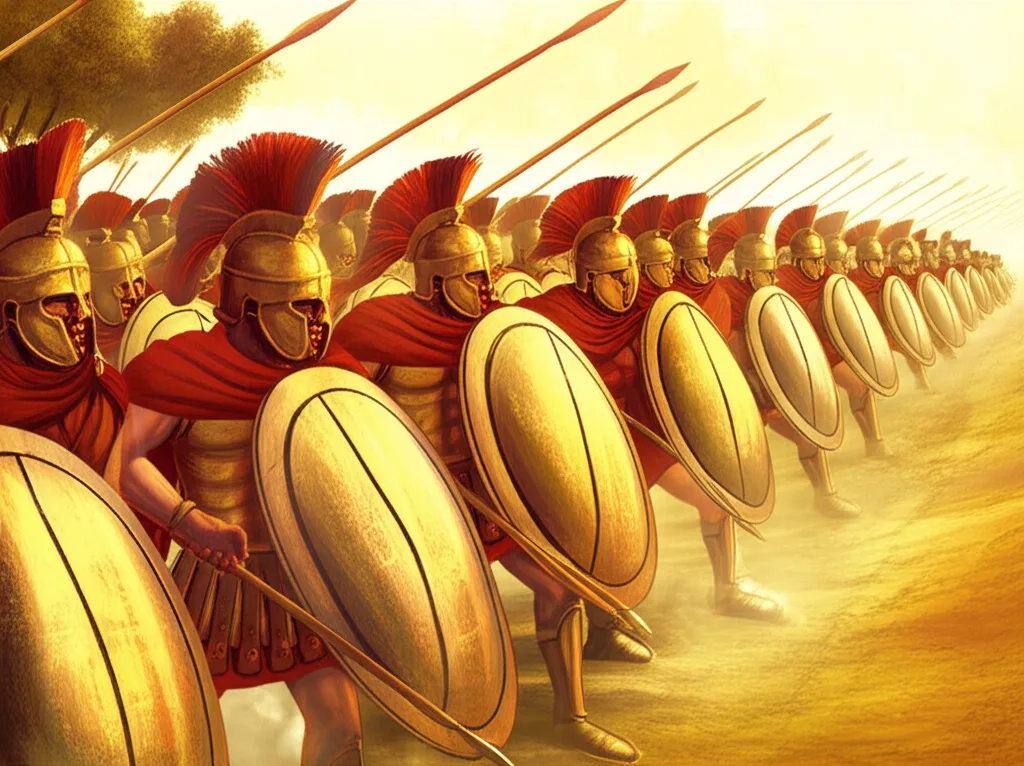
Ancient Greece turned warfare into a discipline. The hoplite phalanx, eight or more ranks of heavily armoured citizens with a large round shield protecting each man's neighbour, relied on cohesion rather than individual skill. At Marathon in 490 BCE an Athenian citizen army broke a Persian expeditionary force, and at Plataea eleven years later a combined Greek army ended the second invasion. The lesson that trained, motivated infantry could defeat much larger forces has been relearned in every century since.
The phalanx also carried a political idea. The men who fought in it were the same men who voted in the assembly, and the equipment they bought for themselves gave them a claim on the state. At Leuctra in 371 BCE the Theban general Epaminondas showed that the formation could be made to think: he massed his best troops fifty deep on the left and crushed the Spartan right before the rest of the line engaged. Philip II of Macedon learned from Thebes, armed his phalanx with the six-metre sarissa, and paired it with heavy cavalry. His son Alexander used that combination at the Granicus, Issus and Gaugamela to conquer the Persian Empire in less than a decade.
- The hoplite shield protected the man on the left, so a phalanx tended to drift right as each soldier sought cover
- Sparta's agoge produced the most feared infantry in Greece but could not replace its losses
- Alexander's Companion cavalry was the hammer; the phalanx was the anvil that fixed the enemy in place
- Staff colleges still study Gaugamela as an example of a decisive stroke at the enemy's centre of gravity
Rome: engineering, logistics and law
Rome won its empire less through brilliance in battle than through organisation. A legion on the march built a fortified camp every night to a standard plan. Its engineers bridged the Rhine in ten days and, at Alesia in 52 BCE, built more than thirty kilometres of double siege lines around a Gallic army. The Roman road network, about 80,000 kilometres of it, was laid out for moving legions, and many modern European highways and railways still follow its lines. Grid-planned cities from London to Cologne began as the rectangular layout of a legionary camp.
Rome also lost, and learned from losing. At Cannae in 216 BCE Hannibal destroyed the largest army Rome had ever fielded, and the state simply raised another. Fourteen years later Scipio beat Hannibal at Zama with an army trained on Carthaginian methods. The disaster in the Teutoburg Forest in 9 CE fixed the empire's northern frontier on the Rhine, which is one reason the boundary between Romance and Germanic languages runs where it does today. Roman military law, rank structure and the idea that citizenship could be earned by service passed into the Western tradition and are still visible in modern armies and constitutions.
- A legion needed roughly a tonne of grain a day for its soldiers alone, plus fodder for thousands of animals
- Roman surveying, water engineering and fortification manuals were copied through the Middle Ages and studied by Renaissance engineers
- The siege ramp at Masada in 73 CE, built by a single legion, is still standing
Technology travelled with armies
War moved technology across the ancient world faster than peaceful trade could. Iron working spread through the Near East after the Bronze Age collapse around 1200 BCE, partly because iron ore was common where tin was not. The composite bow, the siege tower and the torsion catapult passed from Assyria to Greece to Rome, each culture refining what it inherited. From the other direction, the crossbow was in mass use in Chinese armies by the time of Changping in 260 BCE, centuries before it appeared in Europe, and the stirrup, developed on the Central Asian steppe, changed cavalry warfare everywhere it arrived. Gunpowder followed the same routes a thousand years later.
- Iron weapons were not better than bronze at first, but they were far cheaper to make in quantity
- Naval technology advanced quickly wherever Mediterranean powers competed for sea control, from the trireme to the Roman corvus
- The Parthian cataphracts that destroyed a Roman army at Carrhae in 53 BCE were an early form of the armoured knight
Borders, languages and laws
The political map of the modern world still carries the outline of ancient conquests. Alexander's campaigns spread Greek language and culture from Egypt to Afghanistan, and Greek remained the language of government and learning in the eastern Mediterranean for a thousand years. Rome's conquests decided which parts of Europe would speak Romance languages and which would keep Germanic or Celtic tongues. The idea of citizenship, of a republic and of codified law, all shaped by the needs of Roman military expansion, became the intellectual foundation of modern Western states.
Religion followed the same roads. Christianity spread along the Roman road and shipping network and became the empire's official faith after Constantine's victory at the Milvian Bridge in 312 CE. Buddhism travelled the routes Alexander opened into Central Asia. The frontiers those armies fixed, on the Rhine, the Danube and the Euphrates, remained cultural boundaries long after the empires that drew them had gone.
Logistics and the birth of the supply train
Ancient commanders learned early that battles were usually won by whoever could feed and water an army the longest. The Persian Royal Road, Egyptian granary networks and Carthaginian naval convoys were all answers to the same problem: how to keep thousands of armed men alive in hostile territory. Alexander planned his marches around harvest dates and river crossings. Roman quartermasters wrote requisition orders that survive on wooden tablets from Vindolanda on Hadrian's Wall.
The systems built for those armies outlasted them. Standardised weights and measures, state granaries, written contracts, coined money in quantity and centralised tax collection all matured under military pressure. Modern supply chains, whether for an army or a supermarket, still rest on principles first worked out when a quartermaster had to decide how many wagons of wheat a legion needed to reach the Rhine.
What archaeology has changed
Much of our current picture of ancient warfare comes from the ground rather than from texts. Metal-detector surveys at Kalkriese have located the line of the Teutoburg Forest ambush through Roman coins, hobnails and weapon fragments, and overturned the old assumption about where the battle was fought. Survey work at Alesia has mapped Caesar's siege lines in detail. Isotope analysis of skeletons tells us where soldiers grew up, and LiDAR reveals earthworks invisible from the ground.
The main lesson is that ancient combat was messier, more compressed and more mobile than textbook diagrams suggest. It is also a reminder to read the classical sources critically. Herodotus, Livy and Arrian were not neutral, several wrote centuries after the events they describe, and all of them inflated enemy numbers. Modern estimates of ancient armies are usually a fraction of what the sources claim.
Test yourself
Every battle mentioned in this guide is in the encyclopedia. Ancient scenes are among the hardest in the game to name from the artwork, because the equipment changed slowly across a thousand years, so start with the easy ones. Try the Ancient Egypt and Mesopotamia entries first, then see how Rome and Greece compare in Ancient Rome vs Ancient Greece.
Battles in this guide
Each links to its encyclopedia entry with the date, belligerents, result and further reading.
Battle of Kadesh
1274 BCE · Orontes River, Syria
Battle of Megiddo
1457 BCE · Canaan (modern Israel)
Battle of Marathon
490 BCE · Greece
Battle of Leuctra
371 BCE · Greece
Battle of Gaugamela
331 BCE · Gaugamela, Mesopotamia (modern Iraq)
Battle of Cannae
216 BCE · Italy
Battle of Zama
202 BCE · North Africa (Tunisia)
Battle of Alesia
52 BCE · France
Battle of Teutoburg Forest
9 CE · Germany
Siege of Masada
73 CE · Israel
Common questions
How did ancient warfare influence modern civilization?
Paying, feeding and recording an army drove the development of taxation, writing, centralised government and logistics. Roman roads, city plans and law became the infrastructure of Europe, and the borders ancient armies fixed still mark language and cultural boundaries today.
What was the Greek phalanx?
A tight infantry formation, usually eight or more ranks deep, in which each soldier's large round shield protected the man beside him and spears projected over the front rank. It showed that drilled citizen infantry could defeat much larger armies, as at Marathon and Plataea.
Why were Roman roads built?
To move legions and their supplies quickly across the empire. Trade and administration used them afterwards, and many modern European roads and railways still follow Roman routes because the surveyors chose the best lines through the terrain.
How big were ancient armies really?
Smaller than the sources say. Ancient writers routinely inflated enemy numbers, sometimes tenfold. Modern historians cross-check logistics, terrain and population, and conclude that even major armies rarely exceeded the low tens of thousands. Alexander had about 47,000 men at Gaugamela; Darius probably had fewer than 100,000, not the million some sources claim.
Did ancient soldiers wear uniforms?
Not in the modern sense, but units often shared recognisable equipment, shield designs and tunic colours. Roman legions came closest to a true uniform, with regulated armour patterns and unit insignia painted on shields.
What role did women play in ancient warfare?
Rarely in the front line, but women were central to logistics, medicine and the defence of besieged cities, and a few commanded. Artemisia of Halicarnassus led ships at Salamis. Scythian and Sarmatian graves excavated on the steppe have confirmed that some steppe women fought as mounted archers. There is more in the guide to women in military history.
Sources and further reading
This guide was compiled from the works below and standard reference accounts. Battle pages linked in the text carry their own sources. Corrections are welcome via the contact details.
- Herodotus, The Histories: the Persian Wars, to be read with care on numbers
- Arrian, The Anabasis of Alexander: the most reliable ancient account of Alexander's campaigns
- Julius Caesar, Commentaries on the Gallic War: Alesia in the words of the man who besieged it
- Victor Davis Hanson, The Western Way of War: hoplite battle as experience; influential and contested
- Adrian Goldsworthy, The Complete Roman Army: organisation, equipment and logistics of the legions
- Kalkriese Museum and Park: the archaeology of the Teutoburg Forest battle
- World History Encyclopedia: Warfare: free, peer-reviewed introductory articles
Can you name these battles from a picture?
Every battle in this guide is in the game. Try today's Daily Challenge or pick an era in Classic mode.